

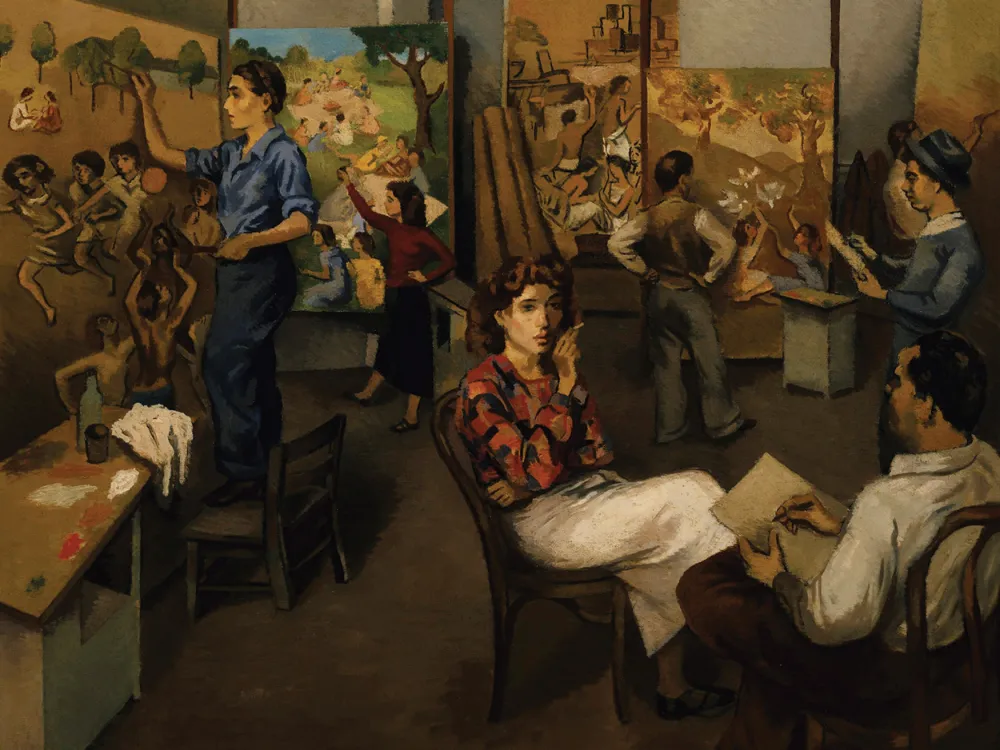
Imagine a world where an artist is considered an essential worker. The government commissions murals and sculptures for schools, libraries, and hospitals. Taxes fund free classes in pottery and printmaking at a community art center. The president of the United States promotes art as vital to a healthy democracy.
This world flickered into view between 1933 and 1943, a decade when the US government treated art as a public resource rather than a private luxury. The output was staggering: hundreds of thousands of artworks—murals, paintings, sculptures, prints, and photographs—by then-unknown artists like Willem de Kooning, Philip Guston, Lee Krasner, Jacob Lawrence, Alice Neel, Louise Nevelson, Isamu Noguchi, Jackson Pollock, and Mark Rothko. They belonged to the era’s bold vision of cultural democracy: art by the people, for the people.
This vision rose from a nightmare: the Great Depression. By the time Franklin D. Roosevelt took office in March 1933, three and a half years after the stock market crash, nearly a quarter of the American workforce had lost their jobs. The banking system verged on total collapse. Impoverished families scavenged for food in dumpsters and burned furniture for heat. The song “Brother, Can You Spare a Dime?” topped the charts. Having promised Americans “a new deal” on the campaign trail, Roosevelt launched an ambitious agenda to pump-prime the economy.
Then, just months after taking the oath of office, Roosevelt received a letter from an old Harvard classmate, painter George Biddle, alerting him that Mexico had hired artists like Diego Rivera at “plumbers’ wages” to paint rousing public murals. Biddle’s letter joined a groundswell of support from citizens ranging from unemployed artists to Roosevelt’s own advisers, encouraging the US government to similarly patronize the arts for public benefit.

But what would a federal art program look like? There were few precedents. Elected representatives, handmaids to private interests, were wary of culture subsidies. (When in 1817 Congress paid John Trumbull $32,000, or approxomately $800,000 today, a senator harrumphed that they “were not worth 32 cents.”) By the time of the stock market crash, access to “high culture” was mostly dependent upon the noblesse oblige of a handful of robber barons whose wealth and assets underwrote a few forbidding institutions in city centers. No more than one in 10 Americans, Roosevelt lamented, could “find out that art is an added enjoyment of life and enrichment of the spirit.”
WITH THE APPROACH of winter, lofty goals met urgent necessity: to put the unemployed artists included to work. The Public Works of Art Project (PWAP) got underway in December 1933, hiring artists across the country to make prints, paintings, and sculptures for tax-funded buildings. The government had recognized, wrote PWAP director Edward Bruce, that the artist “eats, drinks, has a family, and pays rent, thus contradicting the old superstition that the painter and sculptor live in attics and exist on inspiration.”
Bruce, a painter with a useful background as a lawyer and lobbyist, assigned artists the “American scene” as their subject. It was a strategically vague term easier to define in the negative: “Anyone who paints a nude,” sniffed one PWAP administrator, “ought to have his head examined.” Another official compared European modernism to a speculative stock whose bubble had burst.
It was time for artists to climb down from their ivory towers and reenter the currents of American life. The model was regionalist Grant Wood, of recent American Gothic (1930) fame, who ran the PWAP in Iowa and painted glossy murals of ruddy farmers and pristine haylofts for Iowa State University. Wood saw regionalism as the New Deal in visual form: Both affirmed the country’s varied livelihoods and landscapes.

The American scene depended on the view. Aaron Douglas foregrounded the Black experience, from enslavement to the Great Migration, in his Harlem mural cycle Aspects of Negro Life (1934). San Francisco muralists smuggled the Communist newspaper Daily Worker and Marx’s Capital into their compositions. Queer artist Paul Cadmus’s bawdy painting of sailors on shore leave, The Fleet’s In! (1934), was spirited away from a high-profile PWAP exhibition in Washington, D.C., on the orders of an outraged admiral.
Such provocations, Bruce warned, would “discourage further government patronage.” But Cadmus scandal aside, the D.C. exhibition was well received, smoothed by savvy public relations, and earned the consensus that taxpayer money had been well spent. The president and first lady even selected PWAP paintings for the White House. The United States “has accepted the artist as a useful member of society,” Bruce crowed, “and his work as a valuable asset to the state.”
WHEN FUNDING FOR the PWAP expired, after having paid 3,700 artists to make more than 15,000 works, Bruce negotiated a new program to maintain momentum: the Section of Painting and Sculpture. From 1934 to 1943, the Section hired 850 artists to create 1,400 paintings and sculptures for federal buildings, mostly post offices and courthouses.
Today, more than 1,000 post offices nationwide still have Section murals installed over the postmaster’s door enduring proof that Bruce achieved his goal of taking “snobbery” out of art, making it part of the average citizen’s “daily food,” in his words. This “food” was mostly flavorless formulaic views of local history, regional commerce, or the postal service diluted by the lengthy Section approval process. Yet the murals remain a singularly ambitious attempt to map American life, past and present, exposing the fault lines in conflicted visions of national history and identity.
According to its official bulletin, the Section hoped to awaken “faith in the country and a renewed sense of its glorious possibilities.” The able-bodied white male stood for the virility of the New Deal nation state. Broad shouldered riveters, sun-kissed farmers, and brawny bricklayers share in the bounty of a thriving economy steered by enlightened policy. Edward Laning who, along with leftists like William Gropper and Joe Jones, seized the chance to salute the dignity of labor later wrote that painting Section murals meant “learning how railroads were built, and sawmills were operated, and coal was mined, and steel was manufactured.”
A sense of “glorious possibilities” was harder to sustain in the Jim Crow South, where Southern Democrats maintained legal apartheid, and Section murals upheld white supremacy. Murals in the West, crowded with cowboys, prospectors, conquistadores, and missionaries, airbrushed scenes of westward expansion. (Bruce declared a Kentucky mural of square-jawed pioneer Daniel Boone, flexing frontier machismo, possibly the “best thing” painted for the Section.) Ethel V. Ashton’s Defenders of Wyoming County–1778 (1941) defied stereotypical portrayals of women as helpmates and caregivers. They stand shoulder to shoulder with men as musket-wielding protagonists fending off an attack by Haudenosaunee warriors.

Nearly a quarter of Section murals include Indigenous figures, ranging in tone from romantic to racist, evidence of their prominent but equivocal place in the historical imaginary. Few were painted by Indigenous artists. A high-profile exception was the Department of the Interior headquarters in Washington, D.C., where the mural program notarized the so-called “Indian New Deal,” legislation restoring a measure of tribal sovereignty. Artists including Allan Houser (Chiricahua Apache) and Woody Crumbo (Citizen Potawatomi Nation) honored Indigenous lifeways even as more critical themes of genocide or forced assimilation remained off-limits.
THE SECTION WAS NOT a job-creating program. Then as now, artmaking was not readily considered real work, and officials prioritized the quality of the art over the quantity of artists hired. As high unemployment persisted, however, Roosevelt signed an executive order creating the Works Progress Administration (WPA), which put millions to work on projects like building schools, paving roads, and sewing clothes.
The WPA provided for culture workers through Federal One, encompassing the Federal Art, Music, Theatre, and Writers’ Projects. But the social benefits of painting a mural were less obvious than those of planting a tree. When asked why taxpayers should fund artists, WPA chief Harry Hopkins barked: “Hell, they’ve got to eat just like other people!”
The risk of starvation was real. “I don’t know how I would have eaten without [the WPA’s] support,” Alice Neel recalled. She nearly fainted with gratitude when she showed up to receive her first government paycheck, the standard $24 a week, in exchange for delivering a painting every month or so. (It was less than the median annual income, but a “prudent couple could survive handily,” another artist remembered, “if they ate with caution and watered down the gin.”)
But Federal One did more than keep unemployed creatives from starving. “The art projects were being set up to deal with physical hunger,” wrote Federal Theatre Project director Hallie Flanagan, “but was there not another form of hunger with which we could rightly be concerned, the hunger of millions of Americans for music, plays, pictures, and books?”
Hopkins tapped Holger Cahill, an expert in American folk art, to help nourish a culture-deprived country as director of the Federal Art Project (FAP). A disciple of pragmatist philosopher John Dewey, Cahill lamented that fine art had become the purview of a moneyed urban elite. Artists seeking fame and fortune in cities had left behind cultural deserts in rural America—a form of “cultural erosion,” Cahill claimed, equivalent to the Dust Bowl’s eroded topsoil. The FAP’s goal would be to expand access to making and experiencing art: cultural democracy in action.

To further the goal, the Project released art from its confines in galleries and museums and displayed it on the walls of schools, hospitals, libraries, and prisons. The FAP was more accommodating than the Section of modernist experiments. Stuart Davis’s Swing Landscape (1938), intended for a Brooklyn housing project, pulses with hot, syncopated colors, while Arshile Gorky’s Newark Airport murals greeted travelers with stylized maps and aeronautical instruments. No site was too humble: Italian-born Cesare Stea sculpted a frieze of pipefitters for a Bowery Bay sewage treatment plant.
Cahill compared New Deal painters to New Deal politicians: Both were “searching, trying to find a way” as the economic crisis opened a space to test new ideas. The “Social Content” artists, as Cahill called them, many from Jewish families escaping violent persecution abroad, exalted the downtrodden and skewered the rich and powerful. Social surrealists painted the American Dream (a phrase coined in 1931) curdling into nightmares of poverty and slum housing. A young Jackson Pollock struggled to synthesize his influences, from regionalism to Mexican muralism, while Mark Rothko (born Marcus Rothkowitz) painted alienated subway stations.
The FAP championed self-taught artists for their “fresh poetry of the soil,” in Cahill’s words. Josephine Joy’s canvases teem with San Diego’s pepper trees and aloe plants. Pedro Cervantes painted jewellike vistas of New Mexico’s tablelands. Time magazine declared Southwestern sculptor Patrociño Barela the “discovery of the year” in 1936 for his compactly powerful wood bultos. William Edmondson, born to enslaved parents in Tennessee, carved stone figures on the WPA in Nashville.

“Prints for the People,” the title of a 1937 FAP exhibition, announced printmaking as arguably the most “democratic” medium. Unlike paintings or sculptures, prints can be reproduced, easily shipped and stored, and sold affordably. (Libraries even lent out FAP prints.) Workshop camaraderie incubated technical innovations. Dox Thrash developed the carborundum mezzotint in the Philadelphia workshop, using the medium’s smoky tones to make atmospheric portraits. Prints could flout the decorum expected of public art; Chet La More’s daring color lithograph of three blood-splattered Ku Kluxers (1939), for example, would have been unthinkable as a mural.
Printmaker Elizabeth Olds complained that limited print editions imposed artificial scarcity when printing innovations could make art as accessible as free public education. In that spirit, the FAP’s Poster Division screen-printed as many as two million posters, commissioned by government agencies for a dime apiece to promote federal theater, workplace safety, planned housing, doctor visits, and trips to national parks. Lester Beall’s designs for the Rural Electrification Administration extolled the benefits of public power.
Photographs, like prints and posters, could be reproduced and widely circulated. They also combined documentary reportage with emotional punch, a match for the Farm Security Administration’s goal of winning public support for its mission to redress rural poverty. FSA photographers fanned out across the country, capturing wrenching scenes of drought-ridden fields, biblical dust storms, and climate refugees—part of a documentary impulse evident in photojournalism, newsreels, and photobooks like the Walker Evans and James Agee collaboration Let Us Now Praise Famous Men (1941). Most famously, Dorothea Lange photographed Florence Owens Thompson and her children in a pea-pickers’ camp in Northern California, subsuming Thompson’s identity as a Cherokee woman into a Depression-era icon: Migrant Mother.

WHEN FSA PHOTOGRAPHER Arthur Rothstein traveled to the predominantly Black community of Gee’s Bend (now Boykin) in rural Alabama, he snapped a picture of Jorena Pettway working on a quilt, part of a tradition acclaimed today for its creative repurposing and visual invention. Yet Gee’s Bend quilts did not enter the FAP’s Index of American Design, an ambitious project that documented, in illusionistic watercolors, everyday objects (weathervanes, chairs, saddles, dolls, dresses) dating from the Colonial era to the Gilded Age. While the Index lauded humble objects made by anonymous artisans, a corrective to art history’s vaunting of individual genius, it was a selective history that privileged Euro American traditions.
The FAP supported craft, the art of everyday life, as grassroots cultural democracy. The Milwaukee Handicraft Project employed a racially integrated workforce to make books, toys, and textiles for local schools and libraries. The Rochester Museum of Arts and Sciences hired a hundred Seneca artists to record Haudenosaunee cultural and material history. At the Design Laboratory in New York, a Bauhaus-inspired curriculum fused hands-on training with advanced design principles. Timberline Lodge, built with WPA labor on Oregon’s Mount Hood, became a showcase for FAP artisans: a cadre of carpenters, carvers, masons, metalsmiths, and weavers handcrafted the Lodge’s custom furniture, textiles, wood marquetry, and wrought-iron fixtures.
Community art centers (CACs) came closest to achieving the FAP’s goal of cultural democracy. Over a hundred CACs across the country, from New York to New Mexico, offered free classes, lectures, and exhibitions to audiences estimated in the tens of millions. Cahill considered children “integral” to the FAP, and examples of the art they made in CAC classes were displayed alongside those of adults in the Project’s exhibitions. Students at the Harlem Community Art Center (HCAC) a vibrant hub for Black creatives like Chicago’s South Side Community Art Center included the precociously talented teenagers Robert Blackburn and Jacob Lawrence. The HCAC hosted “Art and Psychopathology,”a groundbreaking exhibition of art as therapy, featuring works made by mental health patients that expanded the concept of art’s social utility.
The HCAC was not a gift bestowed by a benevolent government. It was the culmination of efforts by the Harlem Artists Guild, founded to lobby for Black artists on the federal programs. They were joined in the fight by the Artists’ Union (AU), an advocacy group and bargaining agent that pushed for better wages and job protections. In an era of surging labor activism, the AU adopted aggressive tactics: In New York, over 200 artists were arrested after occupying WPA offices to protest layoffs. “Art has turned militant,” announced FAP printmaker Mabel Dwight. “It forms unions, carries banners, sits down uninvited, and gets underfoot. Social justice is its battle cry.”
At the same time, the AU supported efforts to make the art programs permanent, a longstanding hope that the state might, in the words of an early statement, “eliminate once and for all the unfortunate dependence of American artists upon the caprice of private patronage.” Yet the value of government support, cautioned art historian Meyer Schapiro, depended on who governed. The totalitarian regimes of Mussolini, Hitler, and Stalin used state-controlled art to sanctify leaders and coerce citizens. In a 1936 essay entitled “The Public Use of Art,” Schapiro warned AU members that state-sanctioned art in the US, with its “naive, sentimental ideas of social reality,” could blunt the edge of protest and ultimately serve the ruling class.

The New Deal art programs, however, were temporary relief measures tangled in party politics. A 1938 bill to establish a permanent Bureau of Fine Arts ran aground in the House as anti-New Dealers in Congress accelerated efforts to liquidate Federal One. The newly formed House Un American Activities Committee (HUAC) deployed a red-baiting playbook, asserting that tax-funded cultural programs were wasteful boondoggles and Communist fronts. It worked: In 1939, Congress axed the Federal Theatre Project and transferred control of the remaining projects to the states.
The entry of the US into the war against the Axis powers in late 1941 shifted the economy from workfare to warfare. The art programs were repurposed to serve the war effort (an “artsenal for defense,” joked one Project artist), but funding and public support withered. Artists might continue to be “champions of the things of the spirit,” as a Section official wrote, but the material needs of the national defense took priority. The WPA dissolved in 1943, “with the satisfaction of a good job well done,” according to Roosevelt, having earned “an honorable discharge.”
THE POSTWAR TRIUMPH of Abstract Expressionism consigned New Deal art to the proverbial dustbin an irony, given how many Ab-Ex artists got their start on the FAP. The McCarthyist Red Scare recast the socially conscious and figurative art of the 1930s in the light of Soviet socialist realism. In this Cold War atmosphere, Barbara Rose, the author of the 1967 survey American Art Since 1900, concluded that the “WPA programs produced almost no art of any consequence that has survived.”
The claim, though easily refutable, is beside the point. The programs’ primary goal was not to produce “rare, occasional masterpieces,” as Holger Cahill put it, but rather to weave art into the fabric of a pluralistic society. In many respects, they fell short. Government work was precarious: Artists might be fired or furloughed with waves of WPA cutbacks. Structural racism and sexism persisted, even when official rhetoric promised progress. Public murals endorsed settler narratives of conquest, racial hierarchy, and resource exploitation. (Controversy still flares up over how to handle murals with dated or insensitive imagery.)
However flawed, the New Deal remains a necessary precedent, given that prospects for cultural democracy are vanishingly remote. Even as culture is made and consumed more than ever before, most artists today are freelancers unprotected by unions, navigating a precarious gig economy alongside rising housing and healthcare costs, all while facing existential threats posed by new technologies. Meanwhile, the federal government has never been more hostile to the concept of art as a public good.
The federal art programs of the past serve as urgent reminders that the US government once considered art a public resource, like electricity or education, and paid artists from diverse backgrounds a living wage to make art for public benefit. The stereotype of the artist as an isolated genius or dissolute bohemian gave way to the artist as a “worker with a brush” a social necessity, just like a plumber with a wrench or a carpenter with a hammer. As debates rage today about the affordability crisis and the crisis of the humanities, the New Deal’s vision of cultural democracy stands ready to be reclaimed and updated for the present.