

James Day has spent twenty-five years building a body of work that refuses to sit still. Since graduating in the summer of 2001, his practice has moved through painting, photography, sculpture and, most recently, diorama making, each shift bringing a new way of looking at the world without ever fully abandoning what came before.
From Bright Colour to Photorealism
The paintings Day made in his early career were bold and bright, the kind of work that announces itself with colour before it asks anything more of the viewer. Over two and a half decades, that approach gave way to something quieter and more exacting: a photorealistic technique paired with a mature, personal form of surrealism. It is a shift many painters attempt and few sustain, and in Day’s case it reads less like a rejection of his earlier style than a slow refinement of it.
An Enduring Fascination with the Islamic World
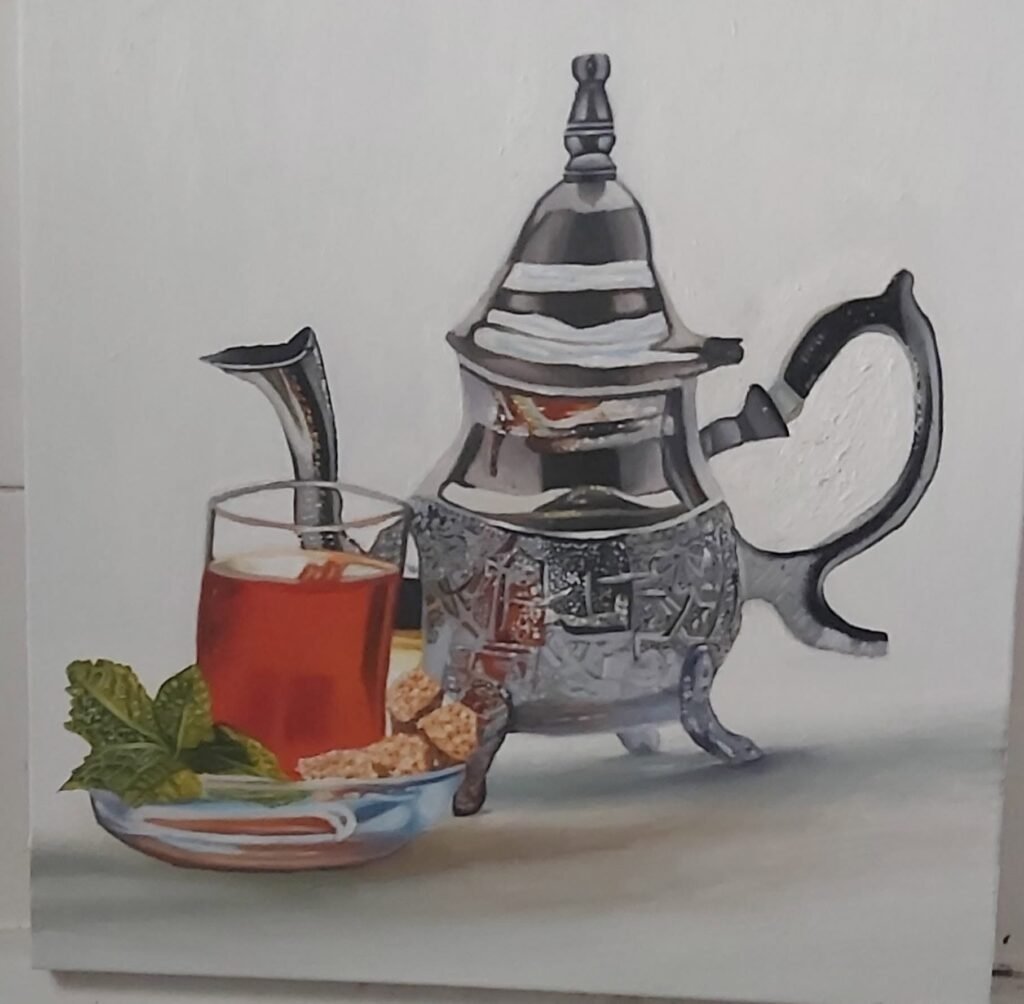
One thread that runs through Day’s career from the very beginning is his interest in the Islamic world. In the 2000s this appeared as bright, exuberant drawings of Islamic architecture. In the 2010s it resurfaced in cartoons drawing on the same visual heritage. By the 2020s, as Day moved into photorealistic painting, that fascination found new form in I Like Mint Tea, a still life of a glass of mint tea beside an ornate Islamic teapot. The painting is deceptively simple in its ambition: Day wanted viewers to feel refreshed simply by looking at it, as though the sunlight and the coolness of the drink could pass through the canvas itself. Seen alongside his earlier Islamic-inspired work, the painting feels less like a new departure than a homecoming, rendered now with the precision his later technique allows.
Dalí, Dreams and the Eye of the Beholder
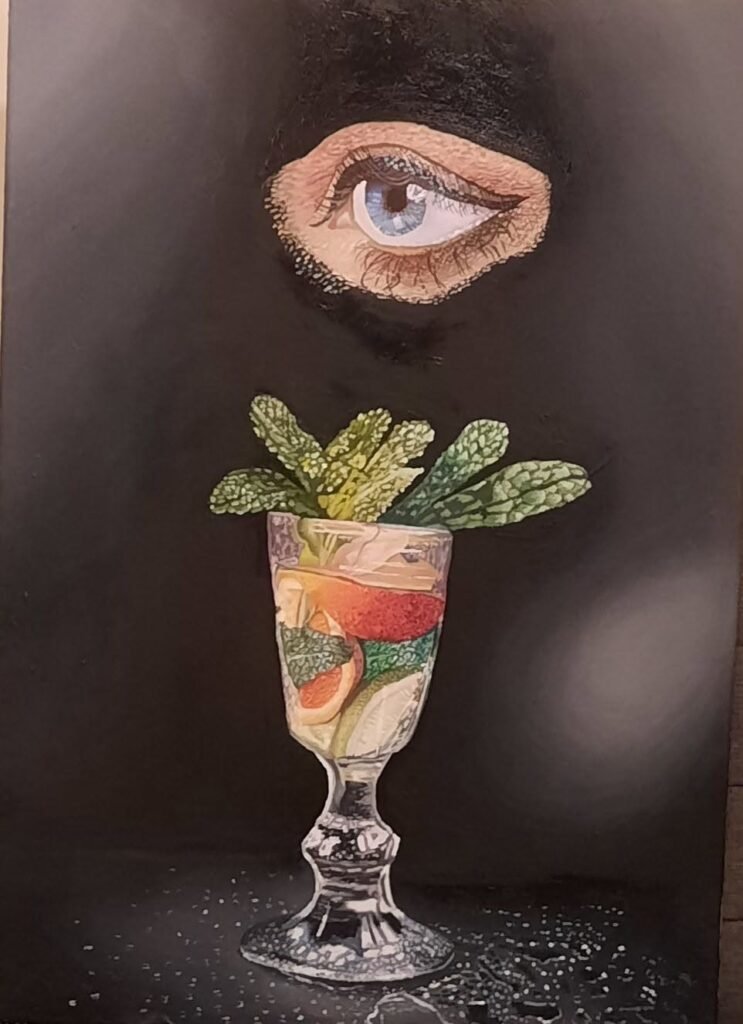
Day’s love of Salvador Dalí and the Surrealists dates back to his school days in the 1980s, long before it surfaced fully in his own paintings. He has spoken of his admiration for Dalí’s contribution to Alfred Hitchcock’s Spellbound, particularly its dream sequence built around imagery of the eye. That fascination resurfaces in Beauty Is in the Eye of the Beholder, one of his mature 2020s paintings, which places an eye alongside a glass of fruit cocktail in a juxtaposition that is odd rather than jarring. The painting does not explain itself outright. Instead it lets two unrelated forms sit side by side, each claiming its own kind of beauty, and leaves the viewer to decide what beauty actually looks like when it is allowed to take more than one shape.
Gravity and the Shoulders of Giants
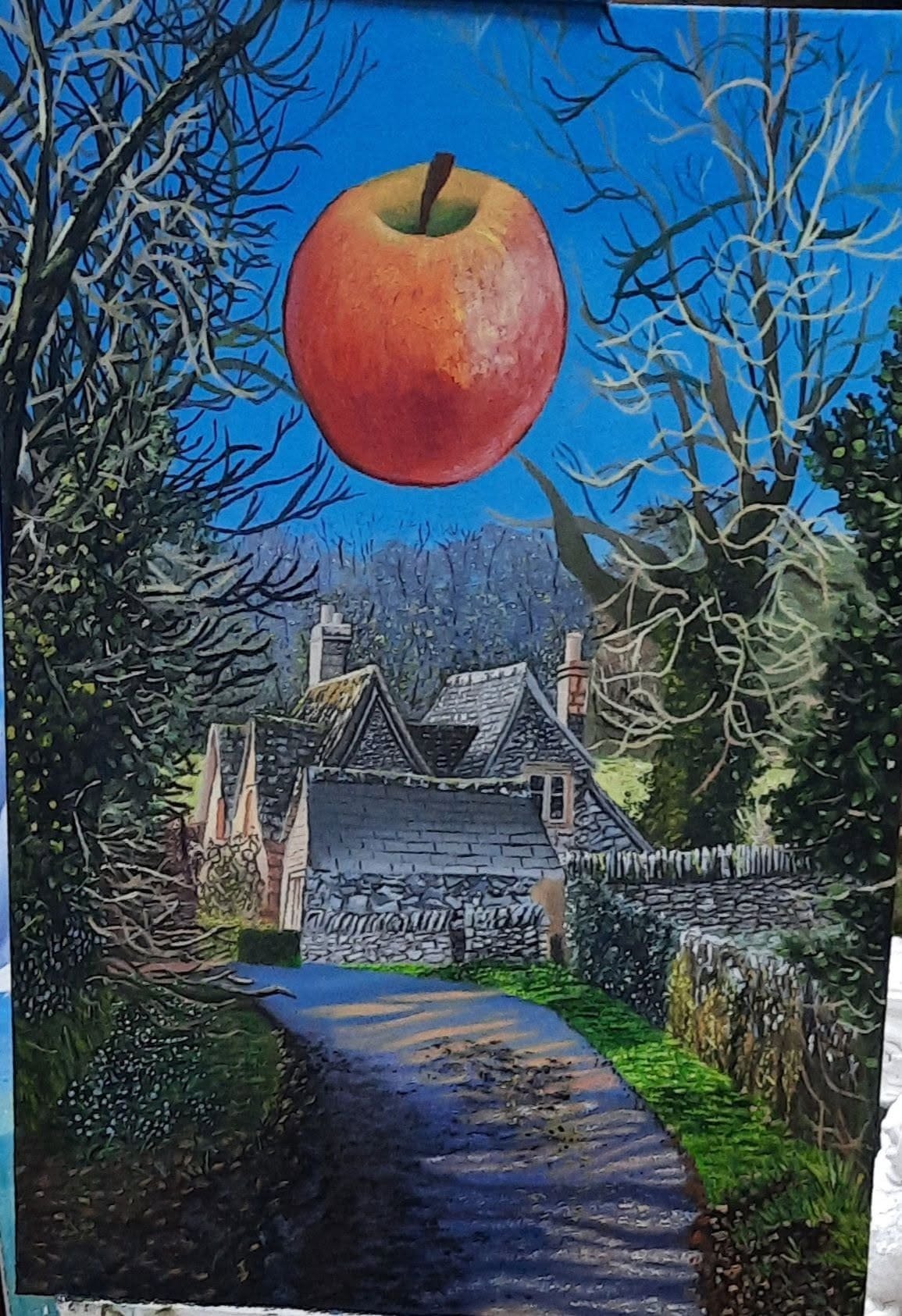
Gravity, painted in 2025, pushes Day’s surrealism further still. An apple hangs in the sky above an English countryside of the kind Isaac Newton might have known, the landscape doing quiet work to root a fantastical image in something historically specific. Day has spoken about the personal resonance of this painting. As an artist with autism, he finds inspiration in figures such as Newton, seeing in them proof that a different way of thinking can also be a generative one. He does not present this as established medical history so much as a personal lens, a way of understanding his own creative process through a long tradition of unconventional thinkers. The phrase he returns to, standing on the shoulders of giants, captures something of how he sees his own place in that lineage: indebted to what came before, but building something distinctly his own on top of it.
Building Worlds in Three Dimensions
Since 2020, Day’s ambitions have extended beyond the canvas. Dioramas and figurative sculpture have become a significant part of his practice, allowing him to construct scenes rather than simply depict them. It is a natural, if unexpected, evolution for an artist whose paintings have always hinted at narrative and constructed worlds; sculpture and diorama making simply let him step inside them.
What Comes Next
Day’s current project, a series of dioramas depicting zombies on holiday, might sound like a departure from the quiet still lifes and surrealist landscapes that define much of his painting career. Looked at differently, it is entirely consistent with an artist who has always been drawn to the unexpected pairing, the ordinary object made strange. Twenty-five years in, James Day remains an artist in motion, still finding new forms for the same restless curiosity that has carried him from bright architectural drawings to photorealist still lifes to miniature scenes of the surreal and the absurd.
Want to see his latest miniature worlds, works-in-progress, and surreal creations up close? Follow James Day’s evolving journey on Instagram at @thequirkypainter5.