

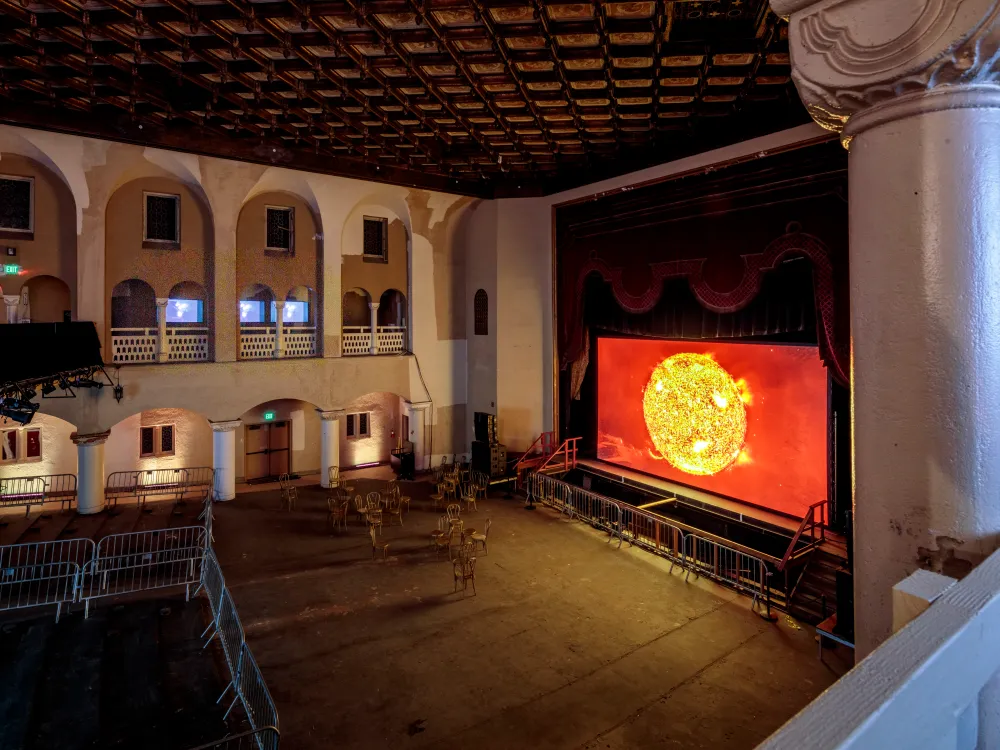
That’s Udo Kittelmann speaking during a tour of “What a Wonderful World: An Audiovisual Poem,” a presentation he organized at the disused Venetian style Variety Arts Theater, a six story Los Angeles palace. On view are selections from the holdings of Julia Stoschek, Top 200 collector who primarily focuses on time based media. Spaces from grand theaters to dingy basements, shadowy bathrooms to dusty hallways host 45 artworks from an international roster including Marina Abramović, Doug Aitken, Chris Burden, Paul Chan, Maya Deren, Cyprien Gaillard, Anne Imhof, Arthur Jafa, Paul McCarthy, Ana Mendieta, Precious Okoyomon, Jacolby Satterwhite, Sturtevant, and Jordan Wolfson.
Stoschek’s collection, managed by a foundation she established in 2002, includes over 1,000 works by 300 artists from the 1960s to the present, and brings together works created in mediums including video, film, installation, performance, and virtual reality. The works are typically on display at exhibition spaces opened in Düsseldorf in 2007 and Berlin in 2016. This is the collection’s US debut, timed to coincide with the recent edition of Frieze LA.
In a nod to the obvious LA’s status as a historical home of the global film industry Kittelmann, a former museum director, has also selected a roster of early cinema classics, including silent films by giants including Luis Buñuel, Walt Disney, and Georges Méliès, to play alongside the contemporary works. “The early films make clear that the technology might have changed,” he said, “but not the topics.”
Another rule, said Kittelmann: “It’s not an exhibition, and I’m not a curator.” It’s a poem, he insists, which, in his view, sets a different expectation for the visitor. Kittelmann’s advice: “Embrace your disorientation.”
Kittelmann organized “What a Wonderful World” to be different from typical museum and gallery shows not only in the ways above, but also extending to the hours 5 p.m. to midnight, in a city that, LA dealer Davida Nemeroff recently told me, after dark becomes “the loneliest place on Earth.” Tickets are free, there’s gratis popcorn at the entrance, and you can amble around aimlessly or view the show in whatever sequence you desire.

Sound bleed is best avoided in traditional presentations, but Kittelmann intentionally allowed the soundtracks to overlap. This might typically drive museum visitors crazy. In this case, it really works. Anyway, Kittelmann selected for works that are mostly non-narrative, so visitors don’t feel they have to enter and leave any given room at any given time, or stick around longer than they wish.
Kittelmann is accustomed to making more traditional shows. He formerly led the Museum of Modern Art in Frankfurt and the Nationalgalerie in Berlin, organizing exhibitions of artists including Carsten Höller, Hilma af Klint, Adrian Piper, Sturtevant, and Jack Whitten. The German pavilion he organized at the 2001 Venice Biennale, featuring Gregor Schneider, was awarded the Golden Lion, the highest honor for a pavilion. Here, he said, he was after something drastically different.
The show’s title refers to the famous Louis Armstrong song of 1967, when its ironic tone was unmistakable in the context of social upheaval, race riots, and the Vietnam War. “It goes with our time and how people feel today,” said Kittelmann, amid violent immigration crackdowns at home and proliferating US wars of choice abroad (with new ones popping off since the show opened).

The Venetian style landmark building, which opened in 1923, has hosted suffragist meetings, performances by legendary figures such as Clark Gable and Buster Keaton, and, more recently, private events from Mexican weddings to punk concerts. Closed for two decades, it’s a little broken down inside, making for a just-edgy-enough setting. The team searched for a space for a year, Kittelmann said, and the quest paid off handsomely. The vast facility allows each work plenty of room to breathe, but you still feel like you’re drifting seamlessly from one work to the next. The Variety Arts Theater has rooms of varying sizes, the main theater featuring a screen 30 feet wide, as well as a ballroom and smaller areas like a former make-up room.
So, what are the topics that Kittelmann alluded to that emerge in the sprawling show’s many works? In the aggregate, they add up to a broad commentary on the human experience, by turns funny, sad, inscrutable, and frightening. In a booklet that comes with the show (bound, cutely enough, in the style of a screenplay you might buy from a sidewalk vendor in New York), Stoschek says, “With the collection I try to create an image of the social and cultural changes of my generation.”
Among the most fearsome works is Jafa’s propulsive Apex (2013), which looms over the show from the wide screen in the central theater like a predator on the hunt. Across its eight-minute-and-22-second span, some 841 images flash by, at a half-second each, to a pounding soundtrack by Detroit techno musician Robert Hood. They include images of star performers and benign pop-culture moments juxtaposed with microscopic images of hideous creatures and the aftermath of ghastly violence. It goes a long way toward achieving Jafa’s goal of “a cinema capable of matching the power, beauty, and alienation of Black music.”

At the other end of the scale in many ways are works in a minor key, like Klara Lidén’s black-and-white Untitled (Trashcan), from 2011, displayed in a hallway, in which the artist, viewed from behind, sits at her desk in a spare room before delivering herself head-first into the titular receptacle, economically capturing life’s absurdity and feelings of futility. The apt soundtrack: Patti Smith’s cover of Neil Young’s 1970 song “Helpless.” Similarly small-scale but gesturing broadly is Kader Attia’s Mimesis as Resistance (2013), which repurposes a David Attenborough BBC documentary segment on the Australian lyrebird as it flawlessly mimics man-made sounds like camera shutters and chainsaws, which may have different meanings for the artist but is for me a depressing commentary on humankind’s spoiling of the natural world.
The US setting for a German’s collection comes through in a number of works that treat American history and culture, like Ant Farm and T. R. Uthco’s The Eternal Frame (1975), focused on an artistic restaging of the assassination of president John F. Kennedy; Chris Burden’s The TV Commercials (1973–77), exploring the place of culture in the country’s mercantile systems; Dara Birnbaum’s Technology/Transformation: Wonder Woman (1978/79), plumbing pop feminism; and Jeremy Shaw’s Quickeners (2014), which appropriates a 1967 documentary about a West Virginia Pentecostal community, adapting it into a low-budget sci-fi in which Quantum Humans have supplanted an extinct humanity. Shaw makes the religious practitioners seem to speak in tongues by simply reversing the audio.

Some of the most technically impressive works use new technologies. Lu Yang’s DOKU The Flow (2024) employs the video-game graphics platform Unreal Engine to create a 50 minute epic in ultra-high definition, with the brightness seemingly set, Spinal Tap style, to eleven. The visual ambition is met with a wide-ranging exploration of the nature of selfhood. Its title character, played by the artist, is named after the Japanese Buddhist phrase dokusho dokushi, or “we are born alone, we die alone.”
True enough, but judging by the crowds streaming through the show each time I attended last week, and by the enthusiasm for the show by every art-world professional I talked to, we live together, for the moment, in the presence of art, and even with some measure of joy.
“What a Wonderful World: An Audiovisual Poem” is on view at the Variety Arts Theater, 940 S Figueroa St, Los Angeles, through March 20, 2026.