

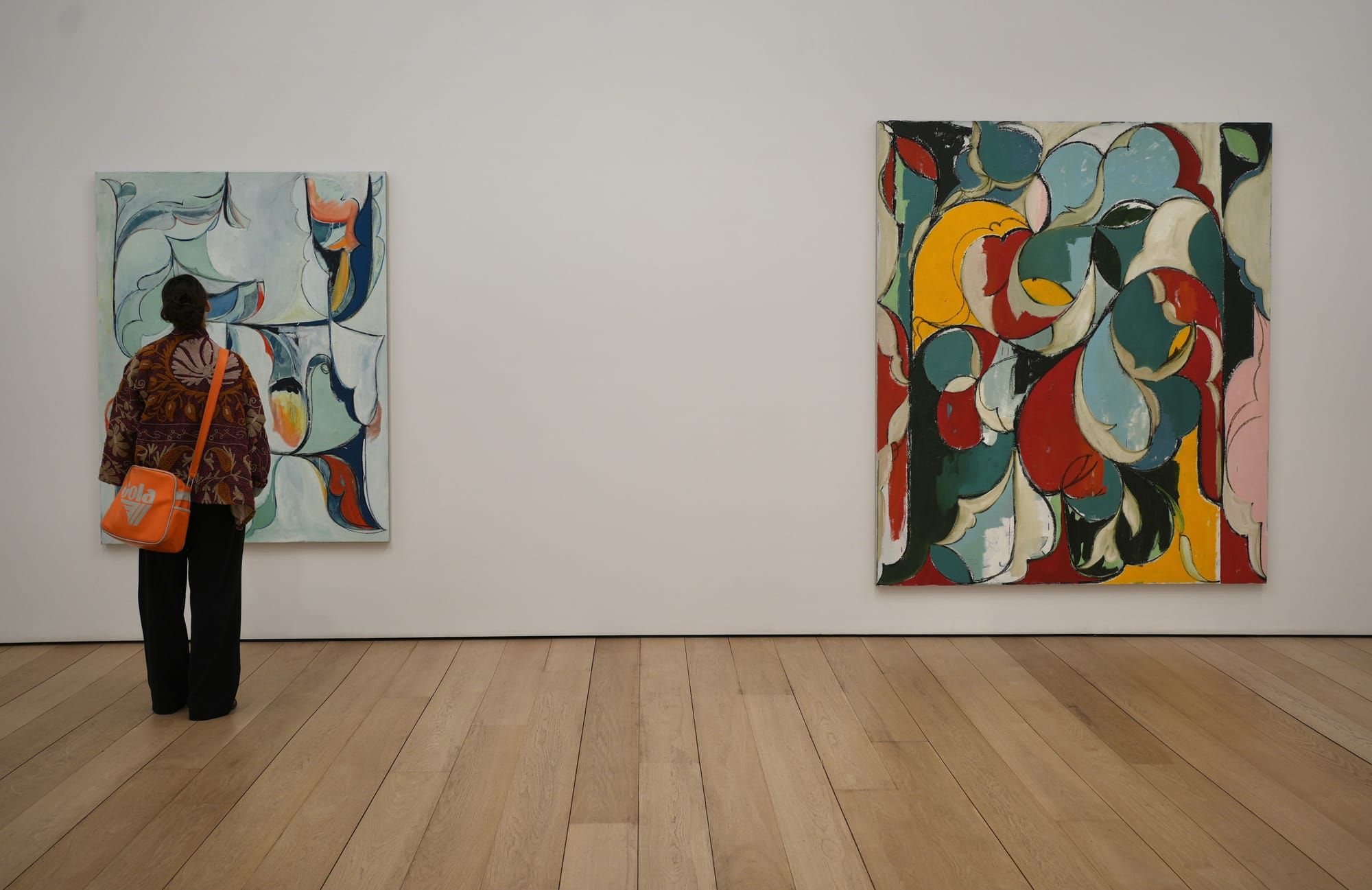
Rather than deconstruct Western modernism or reinsert Islamic visual idioms, the artist loosens the grip of the grid.
A visitor at Kamrooz Aram Infrequencies at Alexander Gray Associates (photo Hrag Vartanian/Hyperallergic)
Kamrooz Aram was everywhere I happened to be these early months of 2026, and I’m all the luckier for it. He exhibited at Nature Morte in Mumbai for Mumbai Art Week, is currently on view at Alexander Gray Associates in Tribeca, and makes a rich appearance almost a mini-solo show in the 2026 Whitney Biennial.
Aram, born in Iran and a graduate of Columbia’s MFA program, is known for his play with the grid. It’s a project that is archeological and critical at once, as it underlies two traditions that are often understood at odds: Western modernist abstraction, on the one hand, and non Western, and specifically Western Asian, decoration (above all, pottery and tilework) on the other. Aram’s paintings, with their gorgeous and provoking palettes (why do his colors seem so familiar and unfamiliar at once?), refuse to understand these two sources as a binary. Such a bifurcation only serves Western modernism’s insistence on self-referentiality and immanence, at the expense of other visual languages. For this painter, the organizing logic of the grid is precisely where order breaks down when it comes to understanding how line, shape, color, and arabesque relate to culture, and how cultures relate to each other.
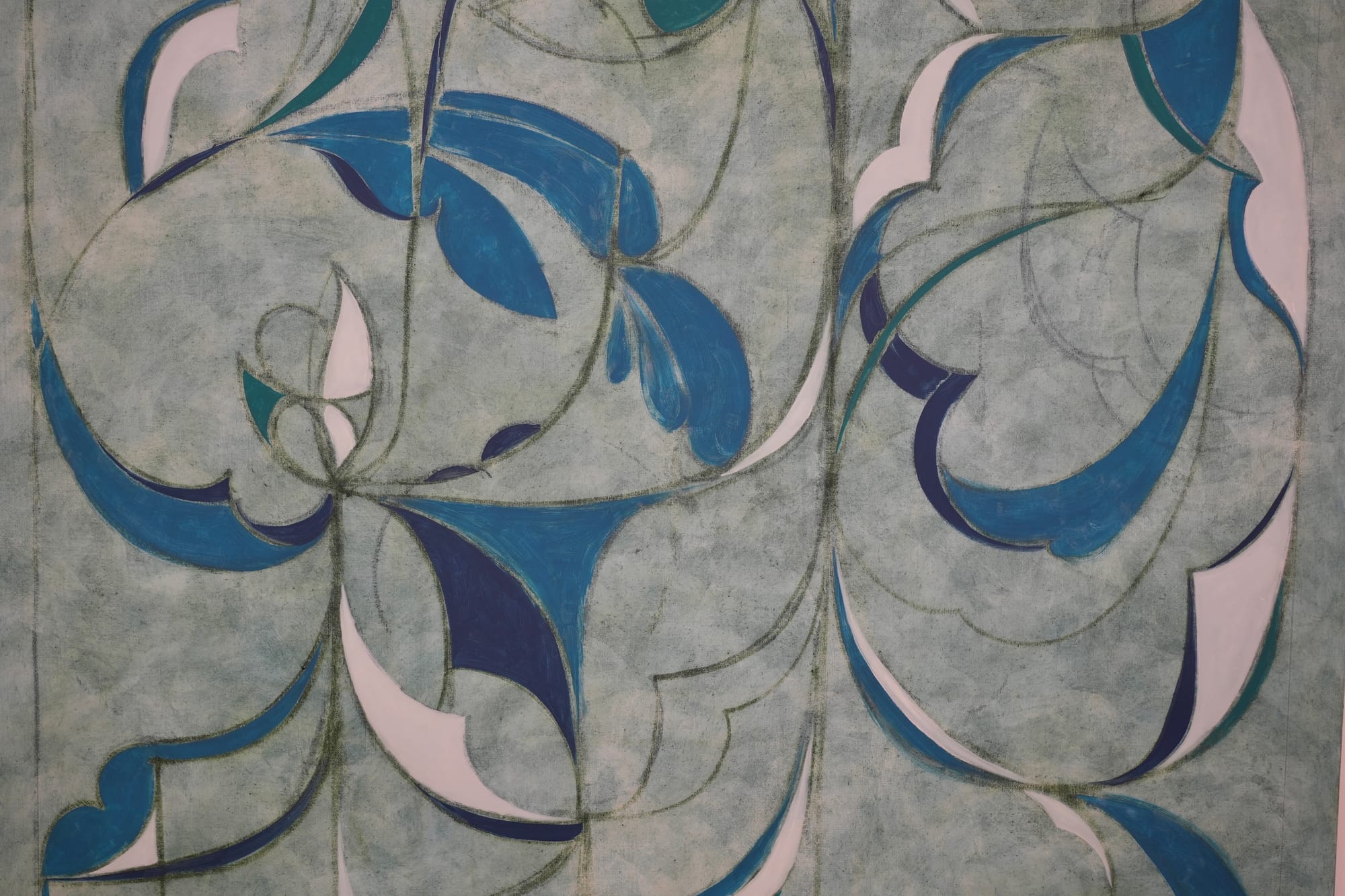
In Mumbai, this grid was on full display, in a series of paintings that emphasized a vertical arrangement across the width of the canvas, interrupted (perhaps complicated is a better word) by curving forms that evoked both the organic (the edge of a flower petal, perhaps a limb or buttock) and the definitively non-organic (enamelwork, the inlay of precious stone in marble). The colors reds, grays, blue greens, midnight blues, blacks, and even yellows likewise sit in a strange space between the natural world and the ur-natural. The problem (or pleasure) of abstraction is the way it acts as a screen for all kinds of projections on the part of the viewer, so indulge me now in my insistence that I saw in these pictures the structure, rhythm, and stylization of Henri Matisse’s “Bathers by a River” (1917), from the Art Institute of Chicago. This callback and I’m sure this is not the only one, by far is less a matter of influence than of recasting. It’s a reminder that Matisse’s arabesque here and in his later abstractions and cutouts, especially was quite literally a borrowing from Islamic decorative arts. Modernists worked their asses off to distance abstraction from the decorative, and declared ornament a crime, but not without absconding with it in the process.
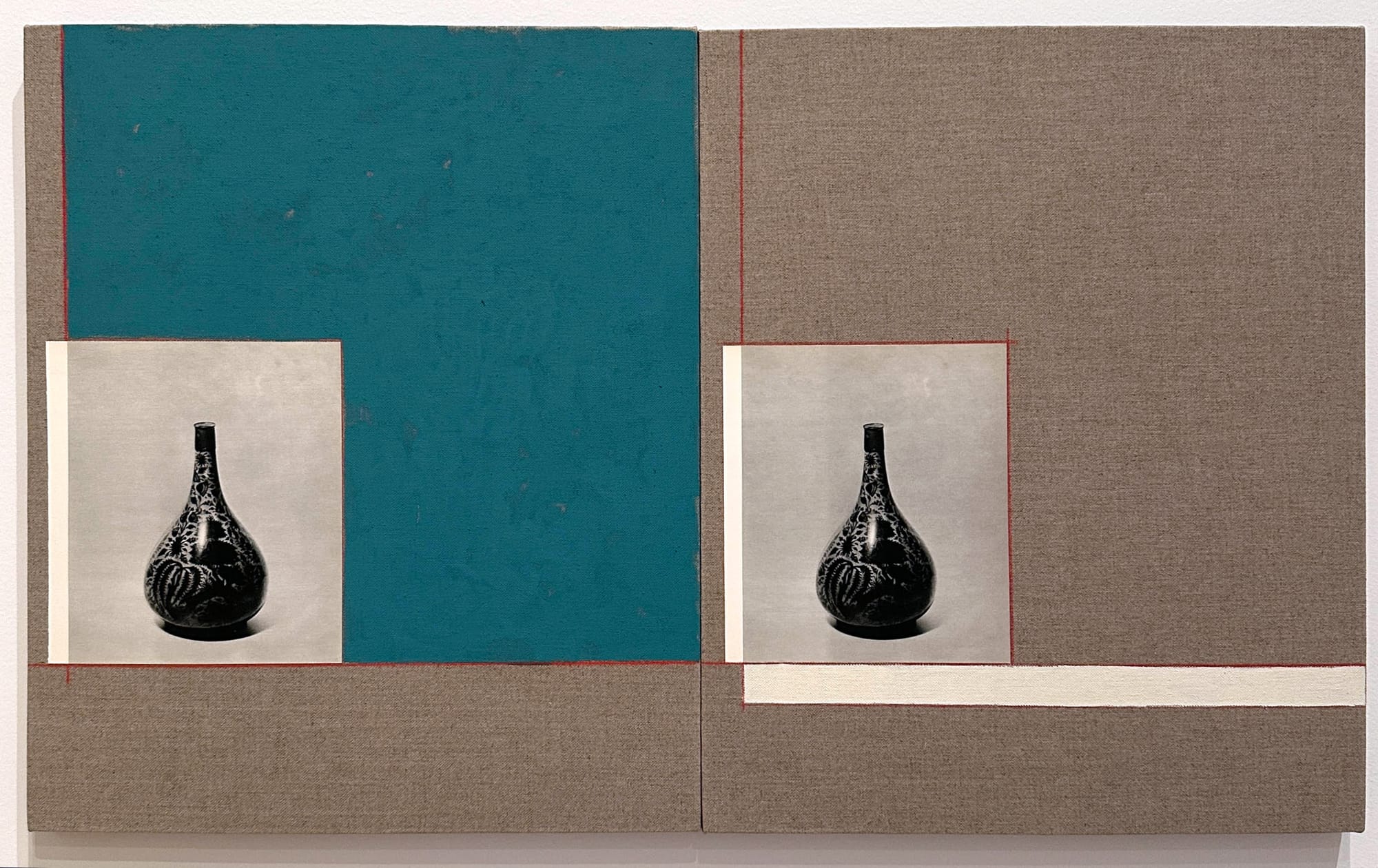
At the Whitney, this insistence on saying the quiet part out loud that Western Modernism was in fact fully imbricated in decoration was on full display. “Descendants (Luster on Blue Glaze)” (2025) takes on art history: Two identical, black and white book pages containing photographs of a marbled vase are collaged onto dun colored linen, which plays double duty as both painting support and book cover a graceful reminder of the role art history has played in cultivating such simplistic, binaristic cultural face offs. On one side of the bifurcated canvas, the picture of the vase is held in a grid composed of red lines and white-painted bars think Mondrian. On the other, it is ensconced in the same red and white grid, but now embellished with a square of Persian blue. This one addition makes all the difference. It’s like one of Hans Hoffmann’s color studies, but instead of just changing your chromatic experience of the vase, that blue changes your geographical and cultural experience of the vase, too.
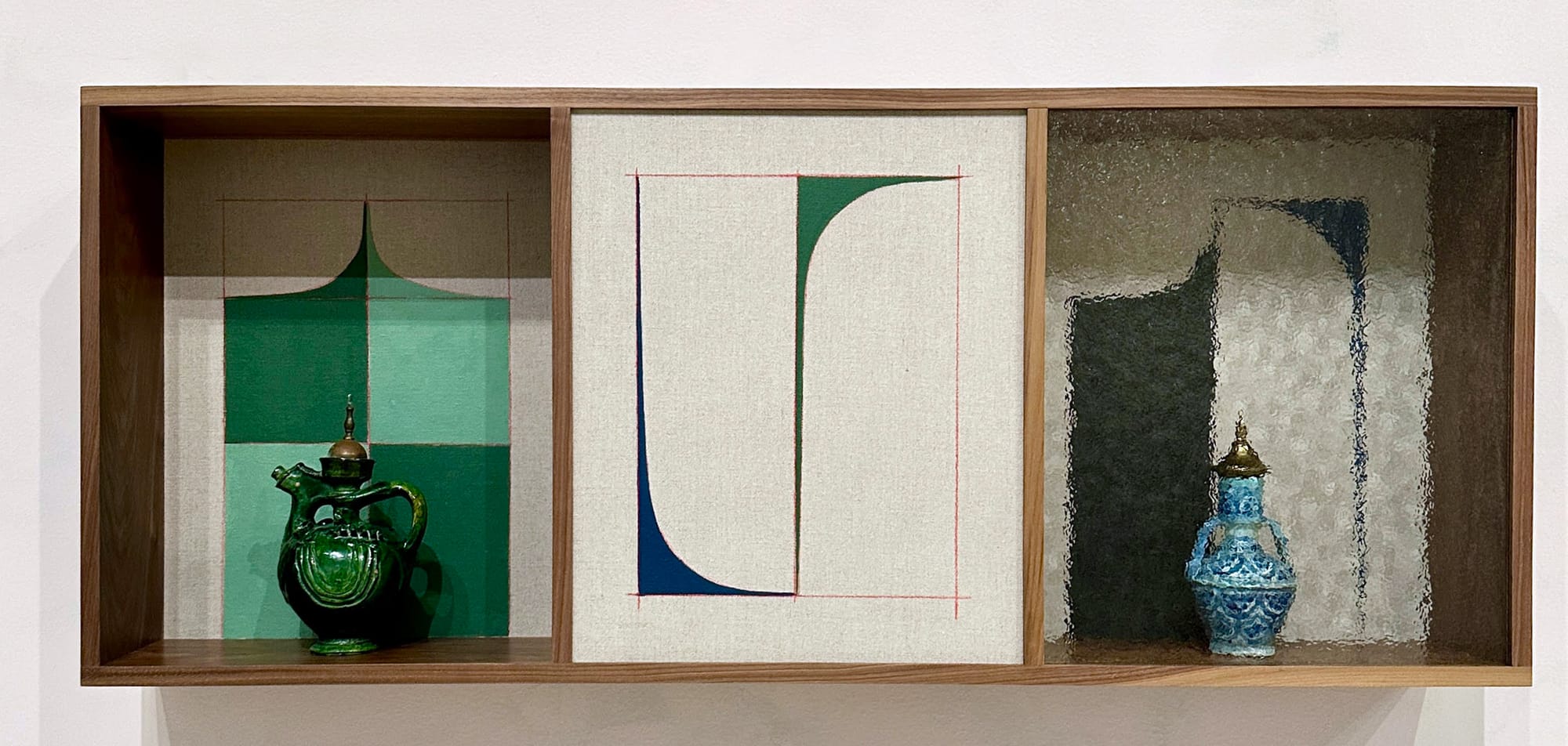
“Requiem for Perpetual Defeat” (2026) offers up real vases or at least, small ceramic vessels this time mounted in a tripartite walnut shadowbox. In the left cubbyhole, a green decanter is set against an abstract composition rendered in oil and color pencil. A linen panel covers the middle part, which includes a bifurcated rectangle, the dividing line curving into a meniscus on each side. In the right chamber, we find a piece of blue pottery set against another abstract composition, this one a kind of inverse of the one on the center panel. But that right section is covered by a panel of textured glass; I did a double take at first, because it looked like nothing so much as a scene from a James McNeill Whistler painting, all orientalism and atmosphere.
My descriptions so far may imply that Aram’s project is simply about deconstructing (Western) modernist abstraction, or reinserting Islamic visual idioms into contemporary abstraction a characterization that suggests that, at the end of the day, the West still has the last word. But I don’t think this is the case at all, nor do I think his practice is as easy to characterize as the Nature Morte show or the Whitney Biennial selections might lead us to believe.
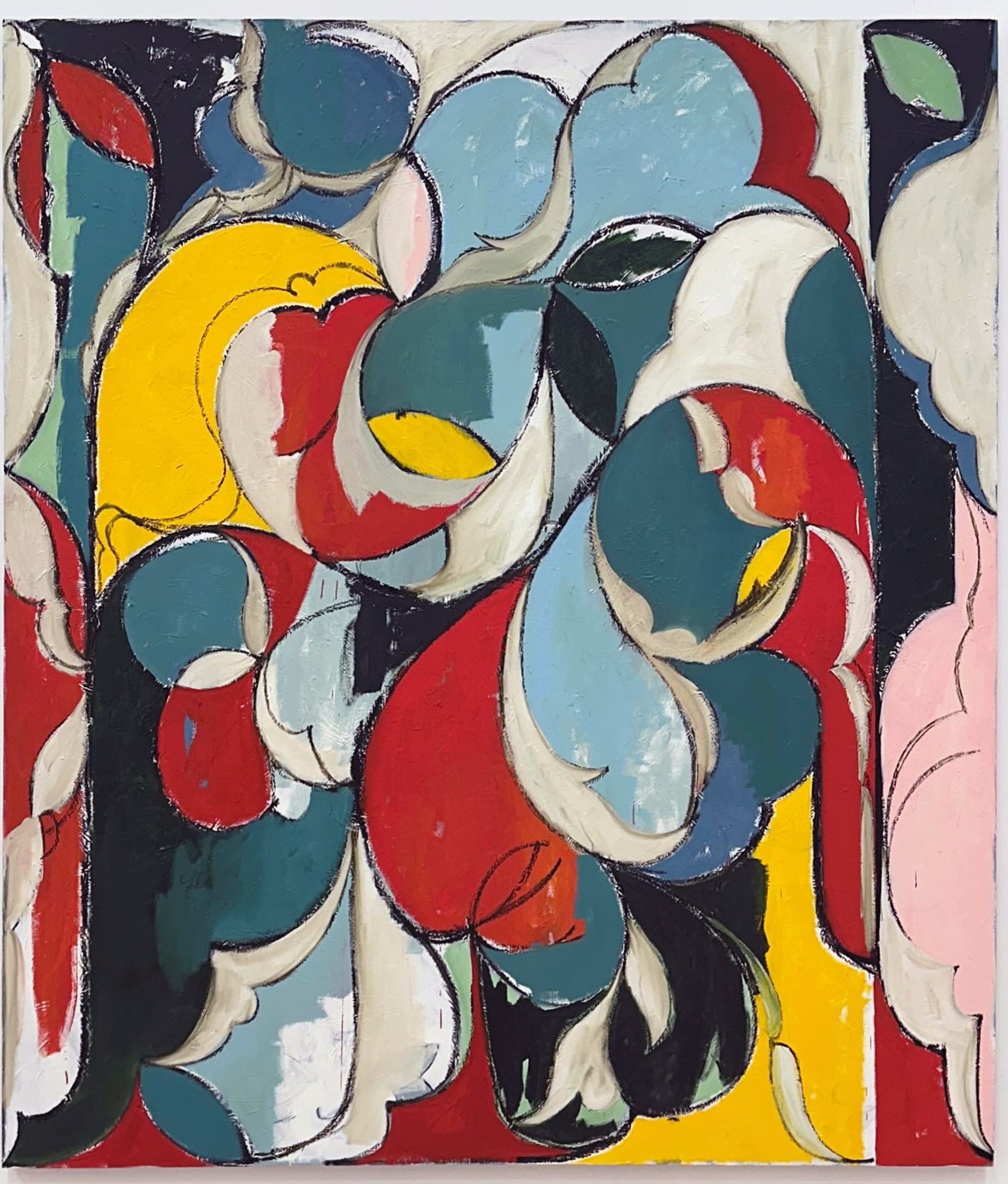
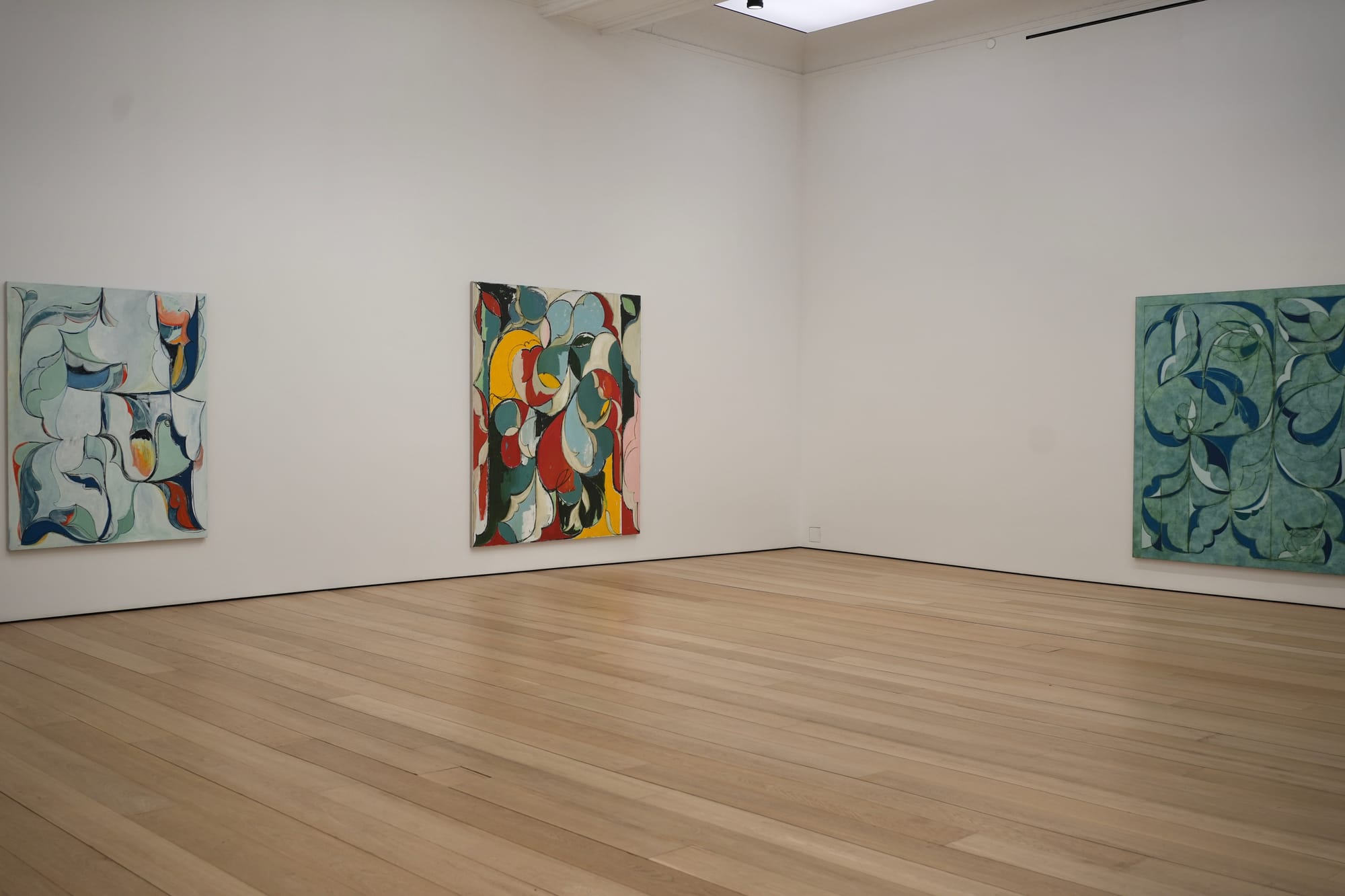
The seven paintings on view at Alexander Gray Associates, all oil, oil crayon, pencil, or wax pencil on linen and made between 2020 and 2026, are, the gallery tells us, a parallel, less regular practice within his practice, one that loosens or subverts the grid entirely under the pressure of gestural brushwork the “Infrequencies” referred to in the exhibition’s title. “Exuberant Flâneuse” (2020) one of my favorites is indeed exuberant, not least because of its riotous palette, all sunny yellows and bright reds, along with the Persian blues and greens and grays and blacks and whites. The grid is there, if you look, but that’s hardly the most interesting thing about it. Now it’s all about brushwork, overpainting and overdrawing, scumbling and scraping, the rhyming and dissonance by turns of the repeated curves, some rendered as drawn lines and others carved out with the brush.
“Old World Telepathy” (2026) is less crisp, more liquid, as if Aram has turned from Matisse to Surrealism or Arshile Gorky or Roberto Matta or no one at all, nothing but his own play with medium and gesture. Look closely at some passages a spot where coral and bright orange and banana yellow are held in place by dark blue and black curves, colors overlapping, stuttering outlines barely managing to contain them. You might see a painterly language that has so fully absorbed all the world has to offer that it has become a chimera without a single source, an idiom with many origins but no hierarchies.
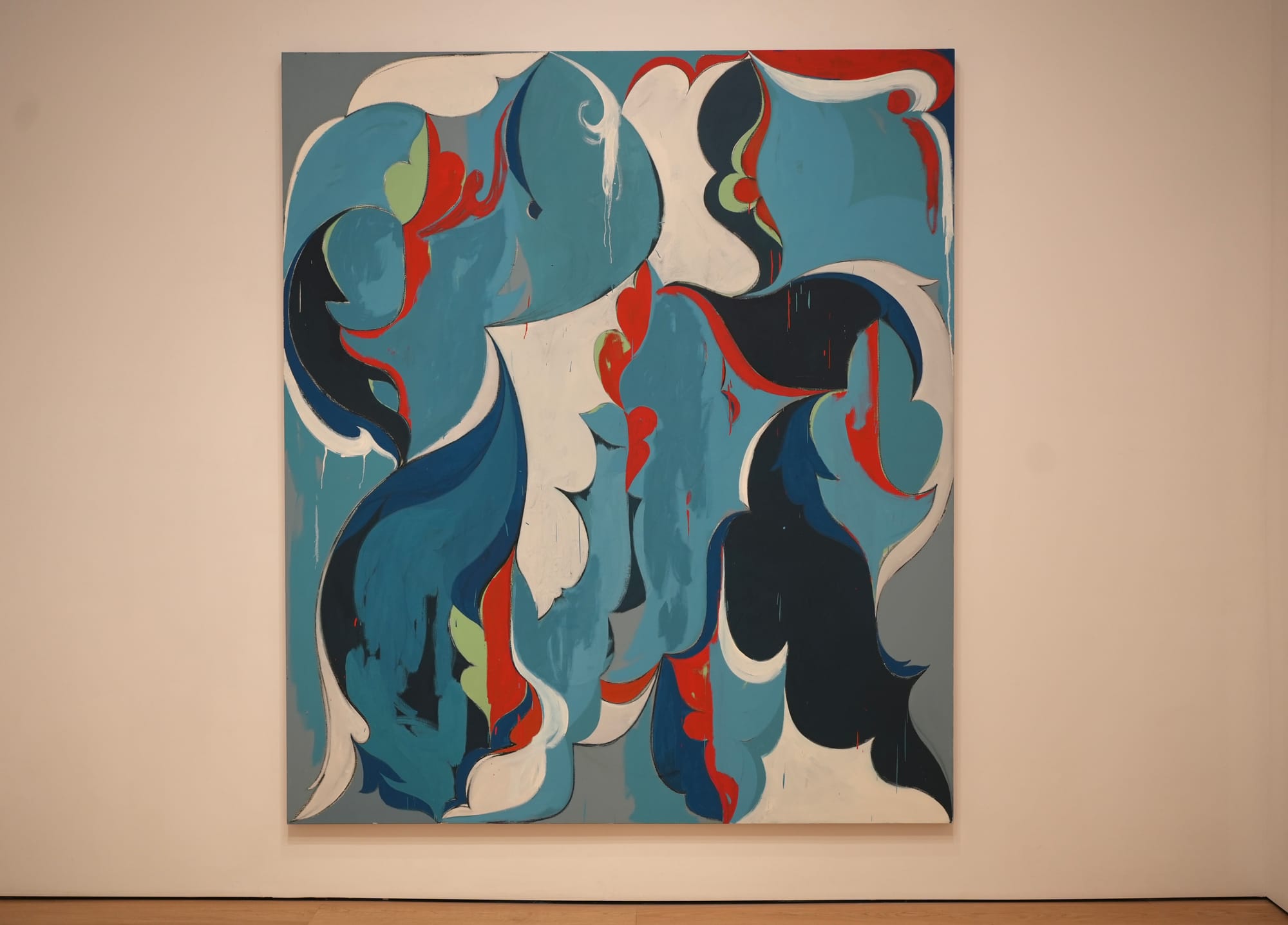
Kamrooz Aram Infrequencies continues at Alexander Gray Associates (384 Broadway, Tribeca, Manhattan) through April 11. The exhibition was organized by the gallery. Aram’s work is also on view at the Whitney Biennial 2026 through August 23. That exhibition was curated by Marcela Guerrero and Drew Sawyer in collaboration with Beatriz Cifuentes and Carina Martinez.