

There is a particular kind of silence that settles over a server room, a hum so constant it becomes invisible. Yi Zhu’s paintings ask what happens when that hum enters the body. In his ongoing series 201 → 429 → 503, the Beijing-based artist borrows the vocabulary of internet infrastructure and folds it into something older and more urgent: an inquiry into how a person survives being endlessly connected.
Yi Zhu did not arrive at this language by accident. His formative years unfolded during a period of dramatic transformation in China’s economy and society, and that instability appears to have instilled in him a mind that treats change as a working condition rather than a disruption. He began as a printmaker and illustrator, developing compositions defined by precise, often unexpected structure. Later he moved into commercial design, eventually leading his own company through China’s advertising and packaging industry, producing work for international consumer brands and earning a Best Creative Award and a Best Supplier Award from a major multinational’s Chinese subsidiary. It was there, inside the machinery of branding and competition, that he began observing something his current paintings still carry: the way systems shape desire, and the way desire, once systematized, starts to press back against the people inside it.
When Code Becomes a Body
The premise of 201 → 429 → 503 sounds technical until you see the paintings. These are HTTP status codes, the terse messages a server sends when a request succeeds, overwhelms, or fails. Yi Zhu is not interested in servers. He is interested in what these codes describe when translated onto skin: a life created, a life overloaded, a life withdrawing to survive. The technological register is a surface. Underneath it runs a much older question about what a body owes to the systems that sustain it.
201 Created: Generation Inside the System
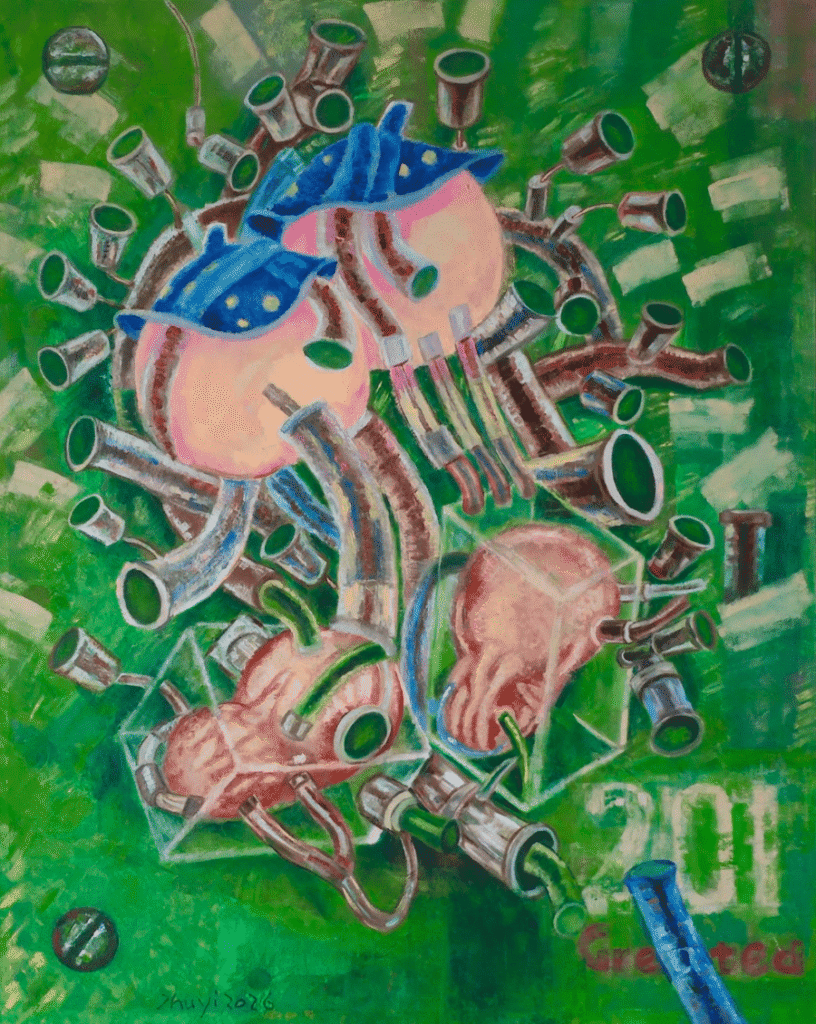
The first movement of the series concerns beginnings. “201 Created” is the response a server issues when something new has successfully come into existence, and Yi Zhu treats this literally, as a metaphor for birth into structure. His figures here appear caught mid-formation, their contours still negotiating with pipelines and interfaces that seem to define them from the outside. The paintings raise a quiet but insistent question: can a life that is generated inside a system ever be said to belong entirely to itself? Soft tissue presses against rigid industrial geometry, and the boundary between the organic and the artificial refuses to resolve cleanly, which seems to be precisely the point.
429 Too Many Requests: The Weight of Being Wanted
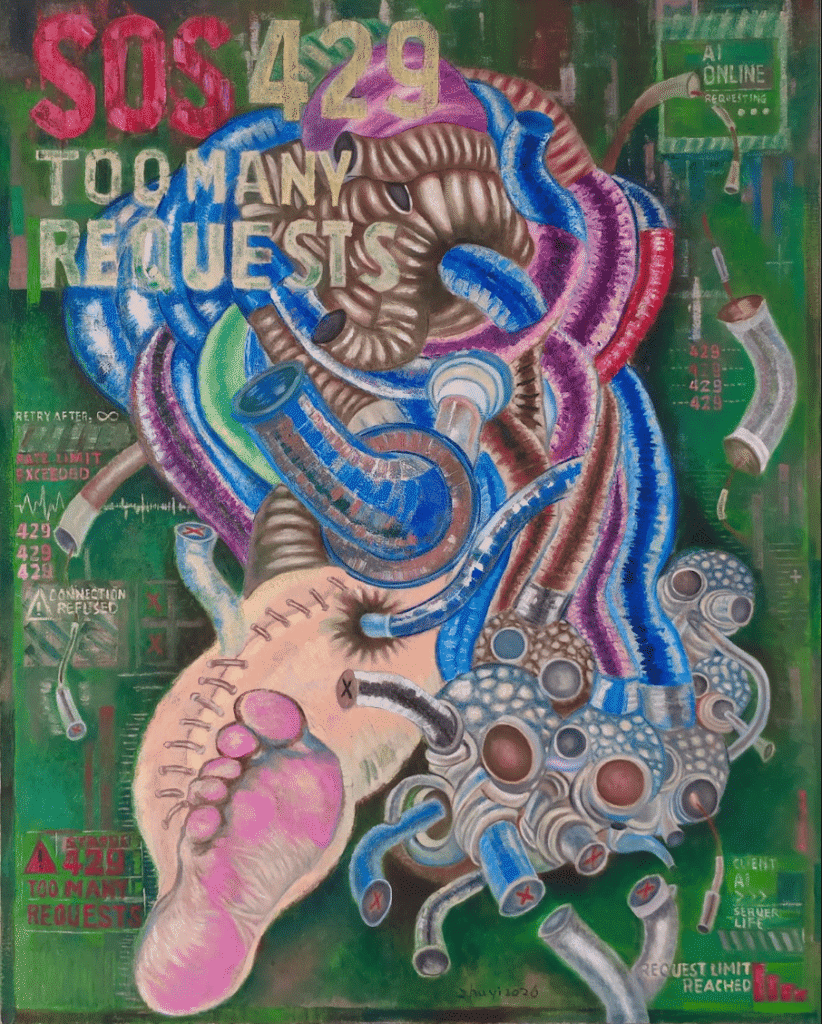
If 201 is birth, 429 is what follows when connection multiplies beyond what a body can carry. “Too Many Requests” is a server’s way of saying it cannot process everything being asked of it, and Yi Zhu extends this into an emotional register that feels immediately recognizable. His figures in this phase appear swollen, stretched, sometimes tearing at their own edges, as though connection itself has become a form of pressure. There is a paradox at the center of these canvases: the more available a body becomes, the less capable it seems of enduring its own availability. Desire and exhaustion occupy the same visual space, indistinguishable at certain angles.
503 Service Unavailable: Withdrawal as Self-Preservation
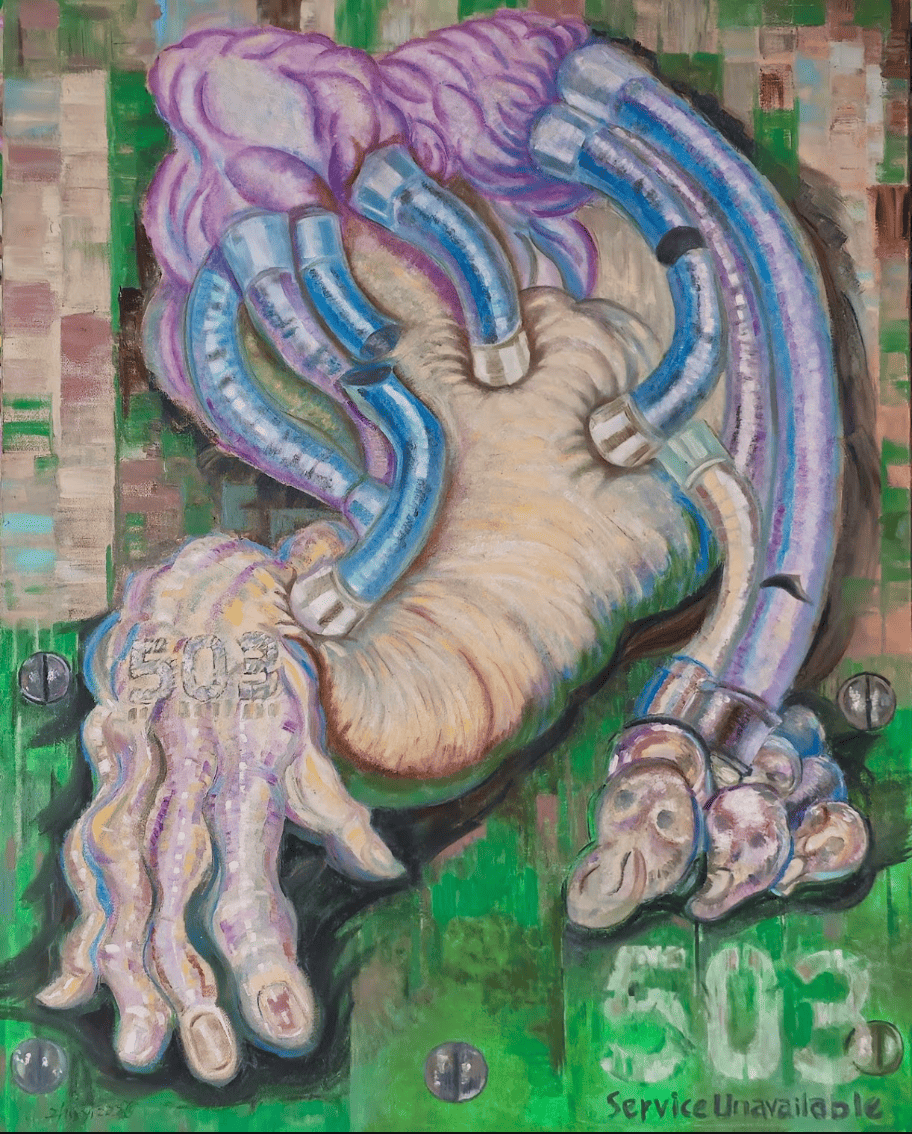
The final status code in the sequence, 503, might initially read as failure. Yi Zhu resists that interpretation. In these works, contraction is not collapse but strategy. Bodies curl inward, disconnect from the pipelines that once defined them, and appear to search for an exit that is also a form of protection. Withdrawal, in this reading, becomes an act of care toward the self rather than a symptom of defeat. The paintings suggest that unavailability, chosen or forced, might be the only remaining mechanism by which a life can preserve what is left of it.
The Logic of Breathing
Underneath the entire series sits an idea Yi Zhu returns to often in describing his practice: that the fundamental logic of life is breathing. Exhalation carries tension, a reaching outward into the world’s demands. Inhalation carries contraction, a retreat into what the body can actually hold. Neither should be permanently suppressed, because freedom, in his conception, is not the absence of systems but the ability to move between expansion and withdrawal without losing oneself entirely. It is a modest, almost physiological definition of liberty, and it gives the 201 → 429 → 503 paintings their emotional undertow. These are not illustrations of a philosophical argument. They are attempts to make that argument breathe.
This body of work, developed substantially during the isolation and reflection of the pandemic years beginning in 2019, has found increasing international visibility. Yi Zhu’s paintings have appeared in exhibitions from Barcelona’s Museu Europeu d’Art Modern to Venice’s ITSLIQUID platform, at art fairs in Innsbruck and Madrid, and across recurring presentations at ArtExpo New York, where he was named Winner of Best Solo Exhibitor in 2023. His 2026 solo exhibition “From Genesis to Presence” in Beijing extends the same inquiry that animates 201 → 429 → 503 into a broader meditation on how existence moves from creation to presence. He has received the Luxembourg Art Prize’s Certificate of Artistic Achievement across multiple consecutive years, gold prizes from the Global Best Creative Awards and the Future Art & Design Award UK, and in 2026 a Platinum Prize in Painting & Fine Art from the UK International AI Award. His painting “See the world” sold at auction through LiveAuctioneers via Chinwe Russell Art Gallery in 2025.
What distinguishes Yi Zhu within contemporary Chinese art is his refusal to treat technology as spectacle. The server codes in his paintings are not decorative gestures toward the digital age. They are borrowed grammar, repurposed to say something that has always been difficult to say directly: that connection sustains us and also strains us, that systems create us and also threaten to define us entirely, and that the right to withdraw, to become momentarily unavailable, may be one of the last freedoms a body retains. In Yi Zhu’s hands, an error message becomes a form of testimony, and a diagram of network failure becomes, unexpectedly, a portrait of what it means to still be alive.
Explore More
- View full details on Yi Zhu’s recognitions and exhibition history at zhuyi.art/awards.
- Follow recent works and studio updates on Instagram @zhuyi515.