

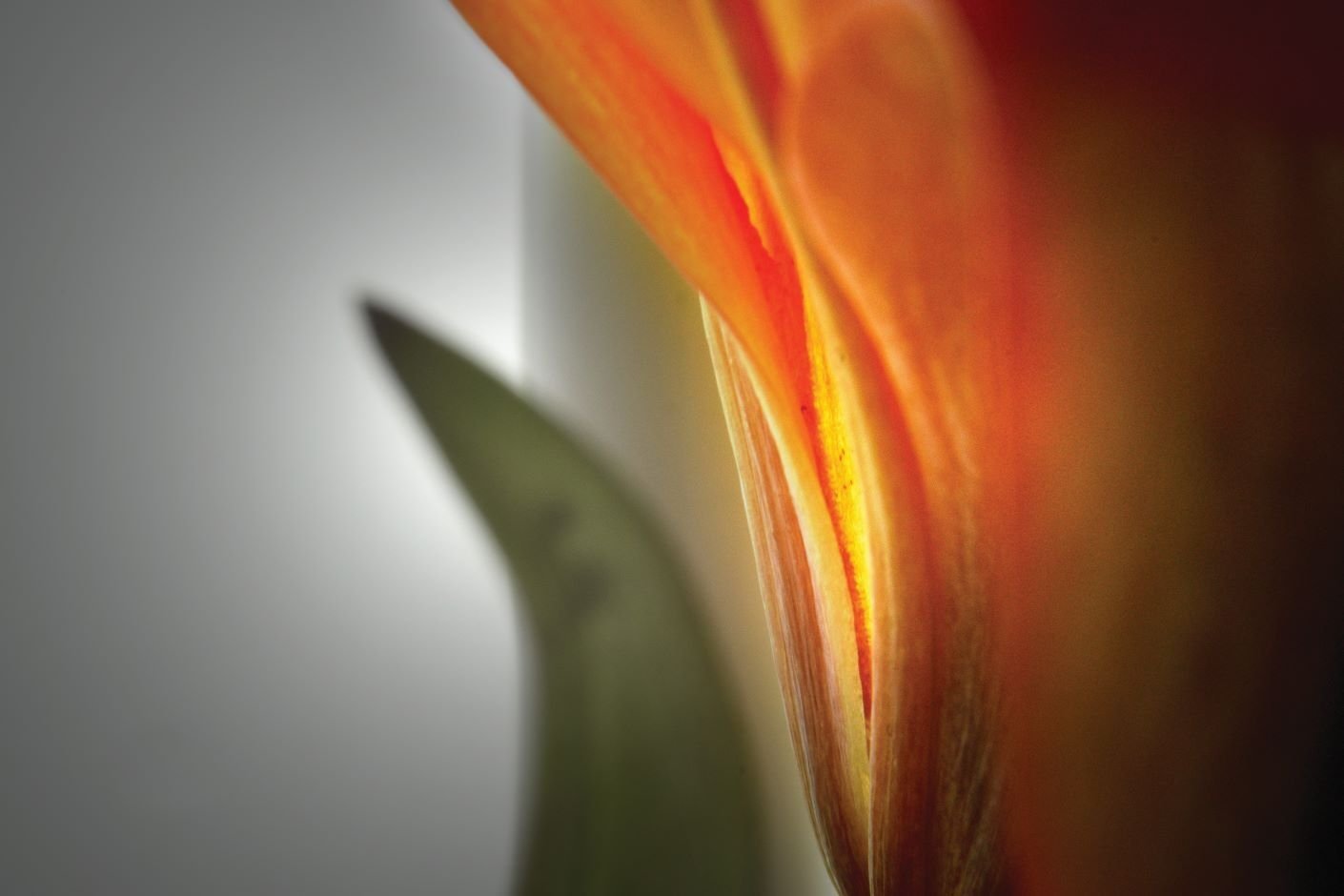
A petal is easy to photograph and hard to see. Most pictures of flowers settle for the bloom as a whole, the familiar silhouette that names its species and asks for nothing further. In Whispers of Golden Fire, Karel Fehr declines that bargain. He moves in on a single curve of orange tissue until the flower stops being a flower and becomes terrain: a smooth slope, a glowing ridge, a shadowed fold, all set against a field of muted grey.
The distance he chooses is the argument of the picture. To understand how a photographer arrives at such a distance, it helps to look at where he has been standing for most of his working life.
Forty Years of Looking at Surfaces
Fehr worked for more than four decades as a commercial photographer, making images of products, landscapes and people for a wide range of clients. His official biography stresses composition and a command of light, shadow and perspective, and the emphasis is less decorative than it sounds. Commercial work is a long education in how surfaces behave under light. A product has to look the way a buyer hopes it will, a face has to survive scrutiny, a landscape has to hold its frame. Every job trains the eye to predict what a highlight will do before the shutter opens.
When he retired from that work, Fehr turned to photographic art, and the change was a redirection of technique rather than a retreat from it. The same literacy that once served a brief now serves no brief at all. His new direction has taken in abstraction, dreamlike landscape and conceptual work, and Whispers of Golden Fire belongs to that lineage. It is the picture of someone who knows precisely how light will travel across a curved, velvety surface, and who is willing to let that knowledge become the subject.
Reading the Image
The official description identifies a single petal curving inward, its orange broken by a luminous golden edge where light seems to pass through the tissue. That edge is the hinge of the composition. Follow the colour along it: saturated orange gives way to yellow, then to a thin line of near white, as though the petal were lit from within rather than from the side. To the left, a grey haze, brightest toward the top, fills much of the frame. A darker green blade crosses it, soft enough to read as the shadow of a form rather than the form itself.
The grey is a decision, not a leftover. Against saturated orange, a neutral ground does two things at once. It makes the warm hue read hotter than it would against black, and it stops the eye from importing a setting. There is no garden here, no sky, no horizon to fix the scale. The petal might be a metre long or a centimetre.
A quiet drama of temperature runs beneath this. The orange sits at the warm end of the spectrum, the grey leans faintly cool, and the pale green blade mediates between them. Nothing in the frame is pure, which is why the petal feels illuminated rather than painted.
Shallow Focus as an Editing Tool
The shallow depth of field completes the abstraction. Only a narrow band of the petal holds sharp focus; the rest dissolves into soft, undefined shapes. This is the moment where observation turns into abstraction, and it happens without any added device. Nothing is invented. Information is withdrawn from the flower, and what remains is light, edge and curve.
The curve itself deserves a note. The petal turns inward, so the eye is led along the bright edge and then drawn behind it into shadow. That inward turn gives the image its sense of depth and its suggestion of something hidden, a sensation the official description likens to peering into the heart of the flower.
Fehr’s wider gallery, which describes its opening collection as abstraction drawn from nature through a macro lens, relies on this method repeatedly. Floral and water subjects are magnified until texture and colour outrank identity. What sets Whispers of Golden Fire apart within that group is its restraint. Many macro images chase intensity from every corner of the frame. This one lets a single hot line of colour carry the picture and trusts the quiet grey to hold it in place.
Scale Against Intimacy
It would be easy to call the photograph a study in contrast and stop there, but the more interesting contrast is between scale and intimacy. The composition feels monumental, like a cliff face at dusk, yet the subject is among the most fragile things a garden produces. That tension is the quiet intelligence of the work. It suggests that the dramatic and the delicate are often the same thing seen from different distances.
The image also shows how a long professional habit can be turned toward private ends. The disciplines of exposure, framing and timing remain, but they now serve an open question: what else hides in a subject we think we already know? Here, the answer is a petal that behaves like a landscape and a light that seems to live inside the flower. As an argument for slowing down and looking again, it is a persuasive one.
Explore more of Karel Fehr’s photographic art at karelfehr.com.