

Fragments of an equestrian statue of King George III, which loomed over Bowling Green in New York City until it was toppled in 1776, open “Democracy Matters,” the inaugural exhibition in the new Tang Wing for American Democracy at the New York Historical. Most of the statue was melted down and reformed into musket balls, and several of these are on display in the opening section of the show across from four large intact pieces of the original. These are framed by an animation of silhouetted figures gathering around the statue in protest, lassoing it with a rope, and then pulling it down a reenactment of a moment memorialized in a painting by Johannes Oertel that is also on view nearby.
Curated by Wendy Nālani E. Ikemoto for the 250th anniversary of the founding of the United States, “Democracy Matters” explores a series of dissonances and conflicts that the nation has wrestled with since its inception. The show frames the American project as defined by a longstanding tension between impulses to maintain the status quo and demands for change. Bringing together fine art and historical objects from disparate figures and events in at times unlikely combinations, “Democracy Matters” suggests that asking what it means to be American and arguing over who gets to claim that identity may be the most consistent throughline across the centuries.

The flag has been a particularly active battleground in these contests. Flag of America (2020), by Mel Chin, has the conventional number of stripes, but its 50 stars are divided into two blocks, with 25 in the upper left corner and 25 in the upper right. Chin’s flag is installed above a vitrine containing two documents: the Declaration of Independence and a petition by 547 loyalists to the King, which New York Historical colloquially calls the “declaration of dependence.” This display, which uses objects from the Historical’s collection to describe central tensions around an issue or event, is indicative of the key storytelling modality of the show.
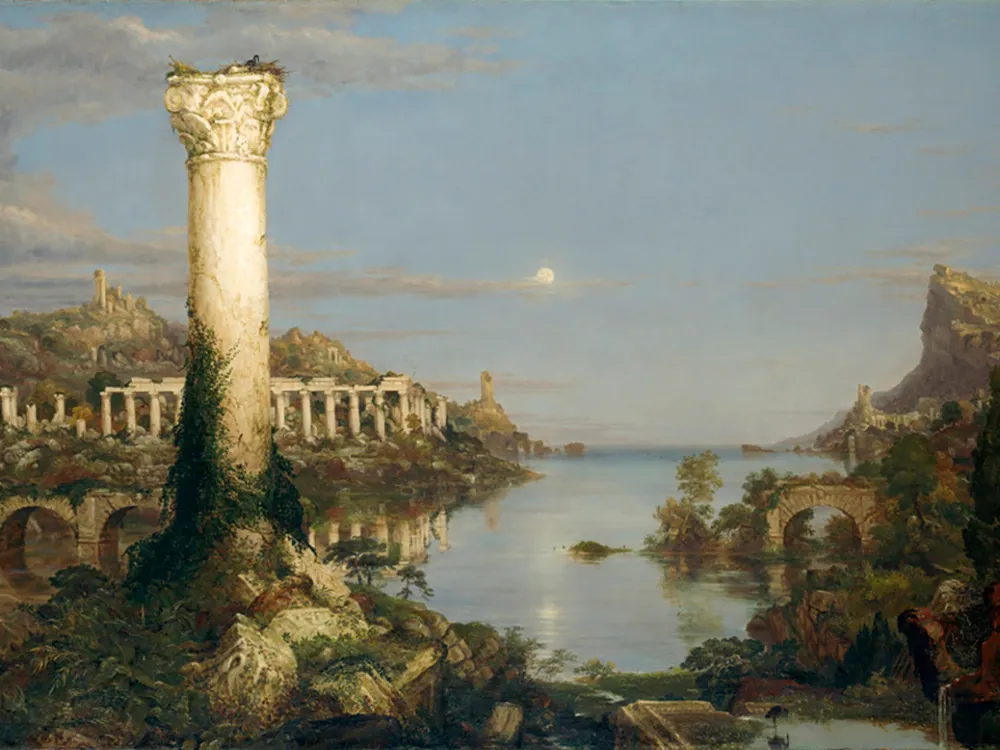
The show’s most memorable vignette centers on Thomas Cole’s Course of Empire, a suite of five paintings made between 1833 and 1836 that occupies a large corner at the back of the exhibition. Depicting the rise and spectacular fall of an Anglo- and Euro-centric civilization, the series was originally presented as an allegorical warning about imperial expansion to the then-young nation. In the context of “Democracy Matters,” its Greco-Roman references and verdant pastoral landscapes read as a searing critique that cultural homogeneity may have caused the downfall of other nations, and that America does not, indeed cannot, mean just one thing if it is to survive.
A smaller but equally powerful juxtaposition pairs John J. Audubon prints of birds alongside brooches of those same species by Yoneguma and Kiyoka Takahashi, a Japanese American couple who fashioned work from found materials while interned during World War II along with some 120,000 other people of Japanese descent, the majority of whom were American citizens. The continuity of subject and species across the two projects speaks to the centrality of birds in American iconography the Bald Eagle, for example, or the 50 state birds which predates but was perpetuated by Audubon’s work. But the vastly different conditions under which these objects were produced at an internment camp and a Pennsylvania estate expose the striated reality behind that iconography. As the wall text notes, Audubon was also an immigrant, but his relative privilege enabled him to become a symbol of a particular kind of American quintessence, a status from which people like the Takahashis have been structurally, often violently excluded.

It is tempting to read the tensions on display through contemporary delineations between left and right, but the show actively resist such readings. A photograph of the Stonewall riots, an etching of the 1680 Pueblo revolt by Cochití artist Diego Romero, and a pair of sculptures by Betye Saar and Augusta Savage capture radically different approaches to struggles for justice.
Elsewhere, a section containing a transparent ballot box from the nineteenth century and a map of Seneca Village detailing the names of individual landowners made at a time when African American men had to own at least $250 worth of property to vote shows how voting rights have repeatedly “been denied or suppressed along democracy’s path.” This implicitly stages our own moment as part of a long standing struggle for voting rights. But it stops short of addressing one critical distinction: those earlier moments of struggle centered around expansion, while our present one concerns staving off curtailment.

The elision of more recent pasts leaves something to be desired elsewhere in the show, too. A larger-than-life painted cast of a statue of Thomas Jefferson, commissioned by Uriah P. Levy, the first Jewish commodore in the US Navy, is included in recognition of Jefferson’s role in committing the nation, at least philosophically, to religious freedom. The cast stood in the New York City Council Chamber until 2021, when it was removed to New York Historical for contextualization in light of Jefferson’s appalling legacy on race and slavery. Yet its didactic label refers only to his “complex legacy including his history as an enslaver,” and its outsized presence in the gallery invites the now-familiar question of whether any amount of written contextualization is sufficient for objects of monumental scale.
The show also includes George Washington’s inaugural Bible and a Torah scroll from around 1730 on loan from Congregation Shearith Israel in New York City, where it was vandalized by British soldiers in 1776. But there are no other religious texts. This may reflect constraints beyond the curator’s control, and religion is not the exhibition’s central subject. Still, in a show about a nation whose leadership increasingly heralds it as a Christian nation in direct contravention of key founding philosophies and in a city long defined by extraordinary religious and cultural pluralism it feels like a missed opportunity to more fully register how central religious struggles have been to the American experience.
“Democracy Matters” offers a substantive and honest account of the deep ambivalences and unresolved tensions at the core the American project, and does not confirm a single coherent vision of the state of the nation today an achievement that that may frustrate some who have come to expect an echo chamber. But the show also leaves it to each viewer to determine whether or how our present moment resembles the past—just as each viewer to choose whether to heed Cole’s warning in his prophetic indictment of empire lurking at the back of the show, or to simply ignore it.