

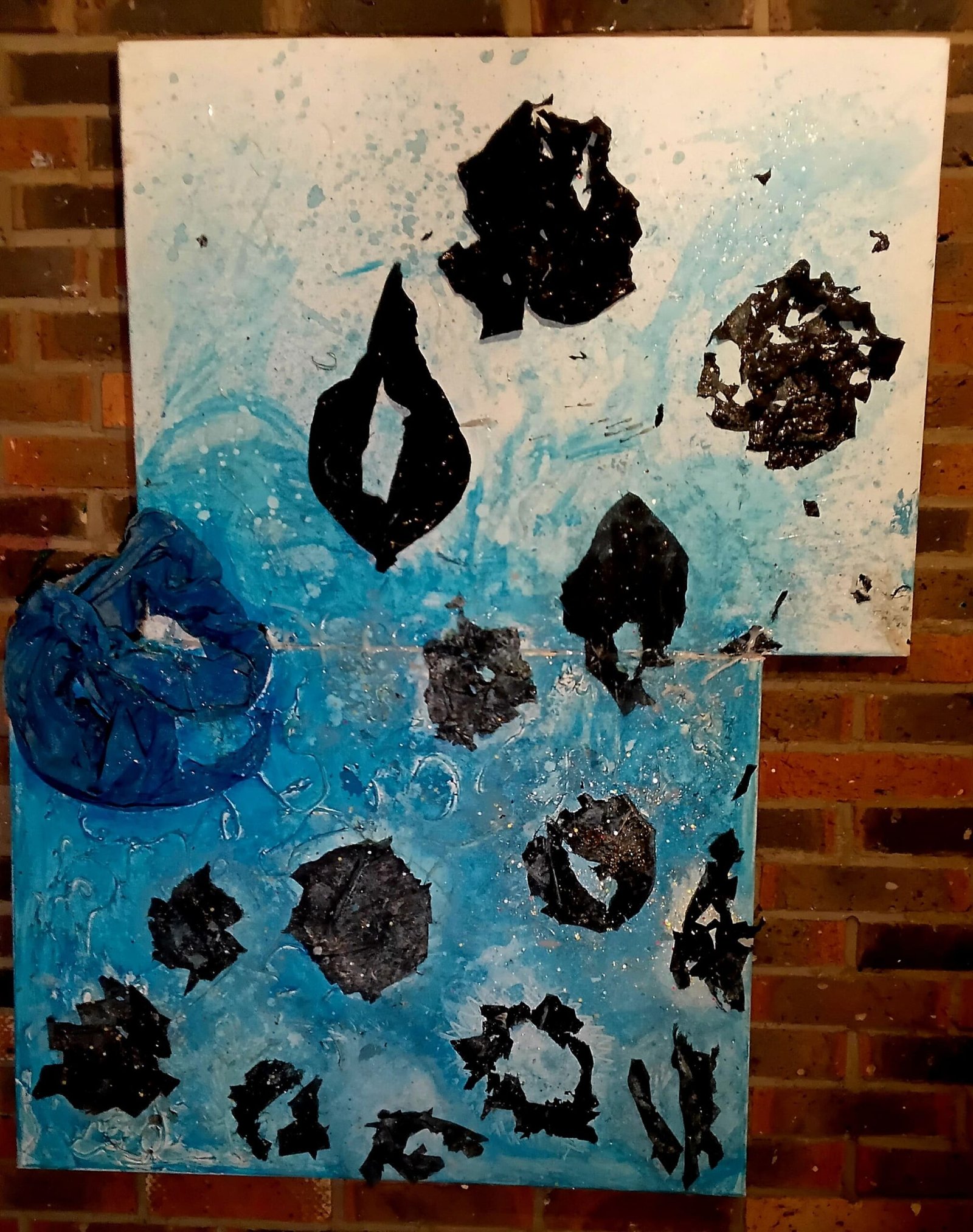
Karla Ochoa Pesantez did not arrive at painting through art school or a slow accumulation of formal training. She arrived at it through the body. Before she ever picked up a brush with intention, she spent years training as a competitive Olympic gymnast in Ecuador, a discipline that demanded exact control over every muscle, every angle, every fraction of a second. Between the ages of seven and fourteen, she won multiple national championships, and in doing so absorbed a kind of physical intelligence that most artists never have the chance to develop. That intelligence, it turns out, translates surprisingly well to a canvas.
A Childhood Between Cuenca and Paute
Born in Cuenca to Luis Alberto Ochoa and Sara Isabel Pesantez, Karla spent much of her early life in the nearby town of Paute, where the rhythms of family life ran alongside the rhythms of craft. Her mother Sara was, and remains, a working artisan, someone who paints, sews, knits, and decorates as a matter of daily practice rather than occasional inspiration. Karla’s free hours as a child were often spent in her mother’s workshop, watching pattern and texture take shape under her mother’s hands. That early proximity to material process left a mark that resurfaces now in Karla’s own layered use of fabric, acrylic, and silicone.
When Athletic Discipline Becomes Visual Discipline
What makes Karla’s current work distinctive is not simply that she once trained as a gymnast, but how directly that training informs her method. She paints freehand, without rulers, stencils, or digital guides, constructing precise geometric forms, straight lines, circles, squares, verticals, entirely by eye and by hand. This is a skill that depends on the same qualities gymnastics demanded of her: spatial awareness, fine motor control, and an ability to hold total concentration over a sustained physical act. She also paints ambidextrously, working with both her right and left hands, which adds a further layer of technical difficulty to compositions that already rely on nothing but her own steadiness.
A Practice Rooted in Faith
Karla did not train formally as a painter. Her path into visual art began later, when her son Inti encouraged her to try it as a pastime, and what surfaced was an ability she had not previously known she possessed. She regards this talent as something given to her rather than something she engineered, and she approaches the canvas with the same discipline she once brought to competition, but now paired with gratitude and daily prayer and meditation. This spiritual dimension is not incidental to her work. It shapes her recurring interest in human kindness, nature, and the idea that all people share a common origin under the same sky.
Universal Geometry and Equality
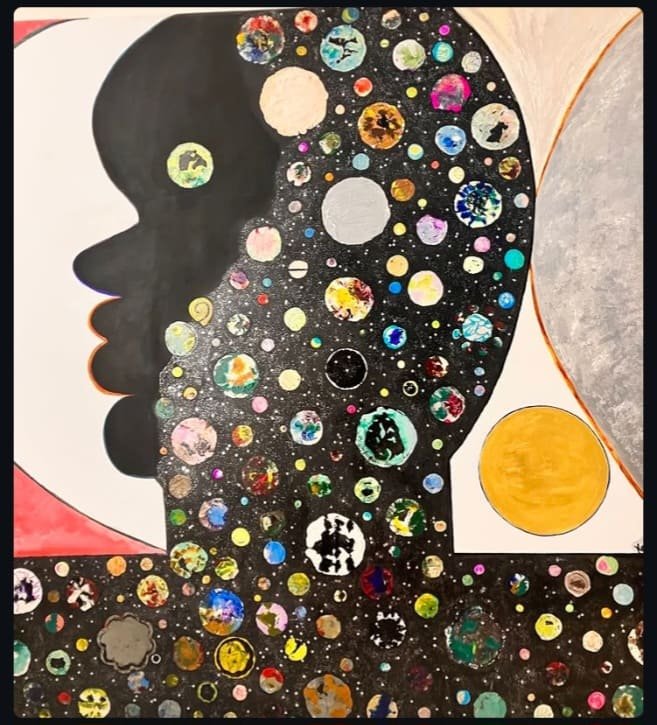
That conviction becomes explicit in “Universal Geometry & Equality,” a work built entirely from freehand geometric construction, circles and lines rendered without any mechanical aid, executed with both hands to ensure they align with precision. Karla has described wanting the piece to carry a message rather than simply demonstrate a technique. At its center sits a dark-skinned human figure, set against cosmic imagery and a dark background threaded with color. The choice of a dark figure is deliberate: it is a direct rejection of racism, an assertion that all people are equal regardless of color, living beneath the same universe. Here, geometric perfection is not decorative. It functions as a formal echo of the painting’s argument, discipline and order standing in for the idea of common humanity, the technical rigor mirroring the moral clarity of the message.
Sahara Sea and the Memory of Water
“Sahara Sea,” completed in July 2026 and measuring 1.80 by 1.50 meters, takes a different route into memory. Karla has spoken of being inspired by the sea as seen from above, its waves and islands forming their own kind of geography, but the piece is equally rooted in childhood, in Sundays spent by the river near her hometown with her family. Built from a combination of fabric, acrylic, and silicone, the work is abstract and constructed to be hung so that it can rotate, with each side offering a different reading of the same underlying pattern. The title honors her mother Sara, linking the piece back to the workshop where Karla first learned to think in terms of texture and material. The work asks something unusual of its viewer: rather than settle on a single fixed image, it invites a shifting relationship with the object itself, changing meaning as it turns.
Reworking Gaudí
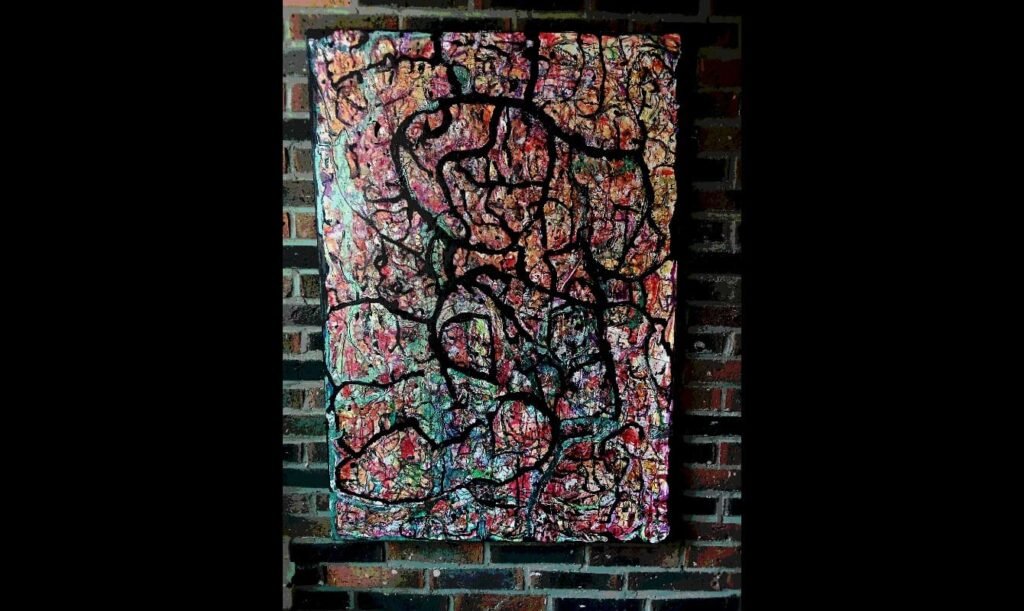
The third work in this grouping takes its starting point from Gaudí, though Karla is careful to treat that influence as a departure point rather than a template. The result is semi-abstract, built from vibrant, shimmering color, populated with characters, faces, animals, and masks that emerge at different scales throughout the composition. Some elements are miniature, tucked into the density of the piece, while others command the eye immediately. The work is designed to be hung and viewed both horizontally and vertically, which means its content literally changes depending on orientation. What Gaudí offers Karla here is not a style to imitate but a permission: to let architecture and color logic inform something entirely her own, filtered through her particular interest in hidden forms and layered perspective.
Technique in the Service of Meaning
Across all three works, a consistent pattern holds. Karla’s technical choices, freehand geometry, ambidextrous execution, mixed material, multi-directional presentation, are never simply displays of skill. They are structural decisions that carry the content of the work. The precision of “Universal Geometry & Equality” argues for order and fairness. The rotating structure of “Sahara Sea” argues for multiplicity and memory that shifts depending on how it is approached. The dual orientation of the Gaudí-inspired piece argues that a single fixed viewpoint is never the whole picture. What began on a gymnastics floor, an early education in precision under pressure, has become, by an unlikely and personal route, a way of building paintings that ask viewers to move, look again, and reconsider what they thought they had already seen.
Follow Karla’s creative journey, behind-the-scenes process, and newest works as they take shape: @art_by_cocoo.