

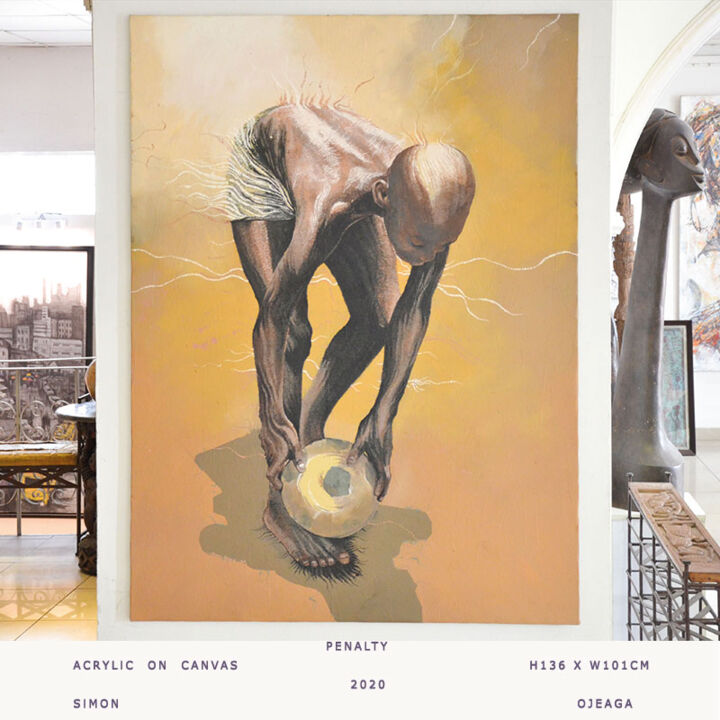
Contemporary figurative art continues to evolve through artists who discover new ways to interpret the human body and communicate movement, emotion, and identity. Nigerian artist Simon Ojeaga has developed a distinctive visual language rooted in repetition, rhythm, and expressive mark-making. Through his paintings, he explores the human figure using countless small, broken lines that come together to create bodies and forms filled with energy.
Born in Edo State, Nigeria, Ojeaga is a figurative artist whose practice demonstrates how a simple visual element can become a powerful tool for artistic expression. Working primarily with acrylic on canvas, he uses lines that move in different directions to construct and interpret the human form. The resulting works possess a unique sense of rhythm, transforming the traditional approach to figurative painting into something dynamic and visually engaging.
A Distinctive Approach to Figurative Painting
At the centre of Simon Ojeaga’s artistic practice is his interest in the human figure. However, rather than presenting the body through conventional, uninterrupted shapes and contours, he builds his subjects through repetition. His paintings are characterized by small, broken lines that move across the canvas in various directions, gradually forming recognizable bodies and figures.
This approach gives his work a strong sense of movement. Each individual mark appears to contribute to a larger visual structure, allowing the viewer to experience the figure not simply as a static subject but as something active and expressive.
The repetition of lines also creates a rhythmic quality. Much like music relies on repeated sounds and patterns to establish rhythm, Ojeaga’s paintings use recurring marks to create visual tempo. The lines guide the viewer’s eye across the canvas, creating a sense of flow while simultaneously defining the structure of the human form.
Through this method, the artist demonstrates that a figure can be constructed through countless individual gestures. The body becomes a meeting point between precision and spontaneity, with every line contributing to the overall composition.
Exploring Movement Through Lines
One of the most compelling aspects of Ojeaga’s work is his treatment of movement. His use of lines traveling in different directions creates an impression of energy within his compositions. Rather than allowing the human figure to remain completely still, his technique suggests motion and transformation.
The broken quality of his lines is particularly important to this effect. Instead of relying on continuous outlines, Ojeaga allows his figures to emerge gradually from a network of marks. This creates a visual experience in which the viewer is encouraged to look closely at how the body is constructed.
The technique also introduces a certain level of abstraction into his figurative practice. While the figures remain recognizable, the individual marks that form them draw attention to the process of creation itself. The viewer can appreciate both the finished image and the thousands of gestures that contribute to its formation.
In this way, Ojeaga’s work occupies an interesting space between detailed representation and expressive abstraction. His paintings are grounded in the human form but are brought to life through an energetic and highly personal approach to mark-making.
Building His Artistic Foundation
Ojeaga’s artistic development has been supported by formal education and practical experiences that have allowed him to refine his creative approach. In 2019, he graduated from the Auchi Polytechnic School of Art and Industrial Design, where he developed a foundation in art and design.
His education provided an important platform for exploring the possibilities of visual expression. However, like many contemporary artists, his artistic development has continued beyond the classroom. His participation in residencies and mentorship programs has allowed him to engage with new perspectives and learn from established figures within the art world.
One significant experience in his career was a five-week residency at the OYASAF Foundation, established by Prince Yemisi Shyllon. Residencies can provide artists with valuable opportunities to concentrate on their practices, experiment with ideas, and engage with wider artistic communities. For Ojeaga, this experience became part of an ongoing process of developing his skills and strengthening his artistic voice.
Learning Through Mentorship
Mentorship has also played an important role in Ojeaga’s journey as an artist. He has participated in programs including Beyond the Canvas and AMG Projects, where he had the opportunity to work alongside established artists such as Ndidi Emefiele and Ayoola Gbolahan.
These experiences provided opportunities for artistic exchange and professional growth. Working within mentorship environments allows emerging artists to observe different approaches to creative practice while also receiving guidance that can help them better understand their own artistic direction.
For Ojeaga, these opportunities have contributed to the continued refinement of his distinctive visual language. His practice demonstrates how artistic development can be shaped by a combination of formal education, independent exploration, residency experiences, and interactions with other artists.
A Visual Language Built on Repetition
Repetition is one of the defining characteristics of Simon Ojeaga’s work. At first glance, the repeated lines may appear to be a purely technical decision, but they play a much deeper role in the construction of his paintings.
Each mark contributes to the overall rhythm of the composition. Together, the lines create texture, movement, and form, while also giving the paintings a distinctive visual identity. The repetition encourages viewers to slow down and examine the work more carefully, revealing the complexity hidden within the larger image.
This method also reflects a sense of patience and discipline. Constructing a figure through numerous small, broken lines requires careful attention and a strong understanding of proportion and form. Ojeaga’s ability to maintain the recognizable structure of the human body while working through such an intricate process demonstrates his technical control.
At the same time, the direction of each line introduces an expressive quality. The marks do not simply describe the figure; they contribute to its energy and atmosphere.
The Human Figure as a Source of Expression
While Ojeaga’s work is technically detailed, his paintings ultimately remain focused on the expressive potential of the human figure. The body becomes a means through which he can explore movement, presence, and visual energy.
His approach encourages viewers to think about figurative painting in a different way. Instead of treating the human body as a fixed image, he presents it as something that can be broken down and reconstructed through rhythm and gesture.
This makes his work both visually precise and emotionally dynamic. The figures appear carefully observed, yet the rhythmic lines give them an energy that extends beyond simple representation.
Continuing an Artistic Journey
Simon Ojeaga represents a generation of Nigerian artists exploring new possibilities within contemporary figurative painting. His work demonstrates how traditional subjects can be approached through innovative techniques and personal visual languages.
By using repetitive and rhythmic lines to construct the human form, he has created an artistic approach that is immediately recognizable while remaining open to continued development. His acrylic paintings combine technical precision with movement, creating figures that feel both carefully constructed and alive with energy.
His journey from graduating from Auchi Polytechnic in 2019 to participating in residencies and mentorship programs reflects a commitment to continuous growth. As his practice develops, Ojeaga’s distinctive use of line offers a compelling perspective on the possibilities of contemporary figurative art.
Through his rhythmic compositions and detailed mark-making, Simon Ojeaga invites viewers to see the human figure not as something static, but as a form filled with movement, emotion, and possibility. His work is a testament to the power of repetition and the expressive potential of a single line, especially when countless lines come together to create something greater than themselves.