

Anna Teresa Laurita’s artistic journey is rooted in a lifelong relationship with creativity, literature, emotion, and the search for meaning. Before establishing herself internationally as a visual artist, Laurita began her creative career as an Italian poet and scholar. Her literary practice led her to author numerous poetry collections inspired by classical literature, including an anthology dedicated to St. Francis of Assisi, as well as a modern novel and two intimate, universal plays. Her literary work received prestigious critical acclaim and numerous awards, establishing a creative foundation that would later influence her approach to painting.
In her mature years, Laurita turned her attention toward painting, a discipline she had contemplated for a long time. This transition opened a new chapter in her artistic life. Through painting, she discovered a visual language capable of expressing emotions and ideas that had previously found their way into poetry and literature. Her expressionist works soon attracted the attention of international galleries, where their distinctive emotional intensity and originality contributed to her growing reputation within contemporary art.
Laurita’s paintings explore subjects that are deeply connected to human experience. Love, faith, longing, spirituality, memory, imagination, and inner transformation appear repeatedly within her work. Rather than simply reproducing the visible world, she transforms familiar subjects through an intensely personal artistic vision.
An Expressionist Language of Emotion
At the center of Anna Teresa Laurita’s artistic practice is the exploration of emotion. Her expressionist approach allows her to move beyond literal representation and create images that communicate psychological and spiritual states.
A bowed face can suggest nostalgia or disappointment. A single tear can become a symbol of hope. A religious figure can represent an individual’s search for faith, while flowers can become manifestations of an invisible force moving through the imagination.
This approach gives Laurita’s paintings a poetic quality. The subjects remain recognizable, yet their meaning extends beyond their physical appearance. Her figures, objects, and natural elements become symbolic vessels through which she communicates personal and universal emotions.
Her background as a poet is particularly relevant to this aspect of her work. Like poetry, her paintings often leave space for interpretation. Rather than providing one fixed meaning, they encourage viewers to bring their own memories, emotions, and experiences into the encounter.
Bell’Amore: Love, Longing, and Hope
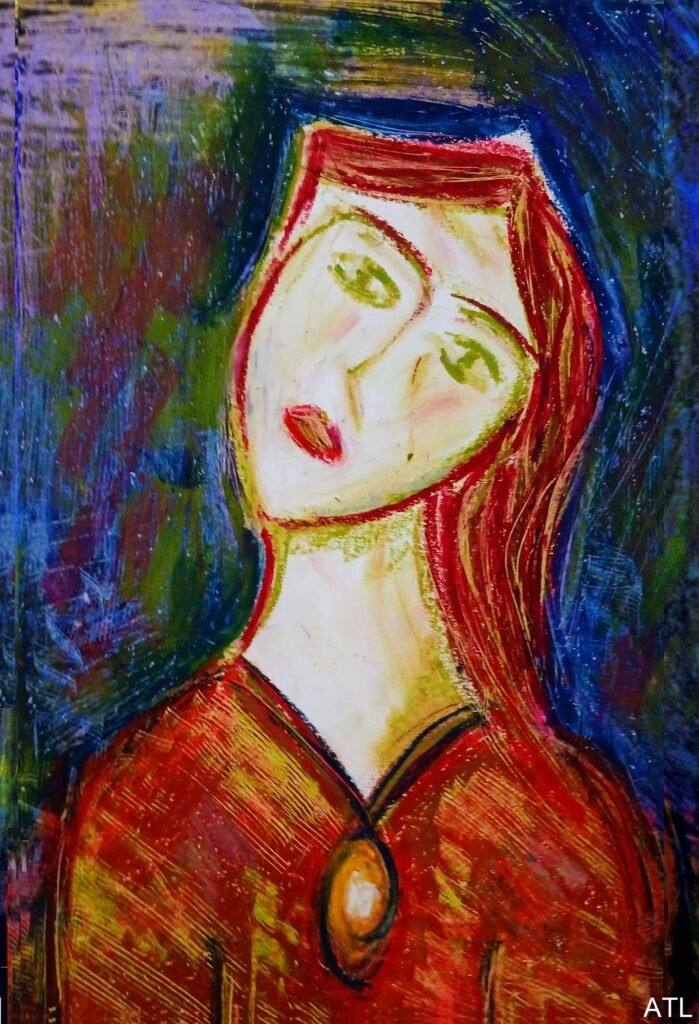
Bell’Amore explores one of the most enduring themes in human experience: love.
The painting presents a youthful figure with a bowed face, seemingly surrendering to romantic nostalgia. The posture conveys vulnerability and introspection, suggesting a person caught between memories of love and the desire for something that might last forever.
The love represented in the work can take many forms. It may refer to a relationship that has faded, a love that has caused disappointment, or an imagined connection that remains beyond reach. This ambiguity allows the viewer to approach the work through their own understanding of love and loss.
A single tear becomes an especially powerful element. It expresses sadness, but it can also be interpreted as a quiet sign of hope. Within this emotional contradiction lies the strength of the painting. Laurita presents love not as a simple or idealized emotion, but as a complex experience capable of creating both pain and possibility.
The emotional tension within Bell’Amore reflects the vulnerability that makes human relationships meaningful. The figure seems caught in a moment between surrender and hope, creating a deeply intimate atmosphere.
Question of Faith: The Search for the Spiritual
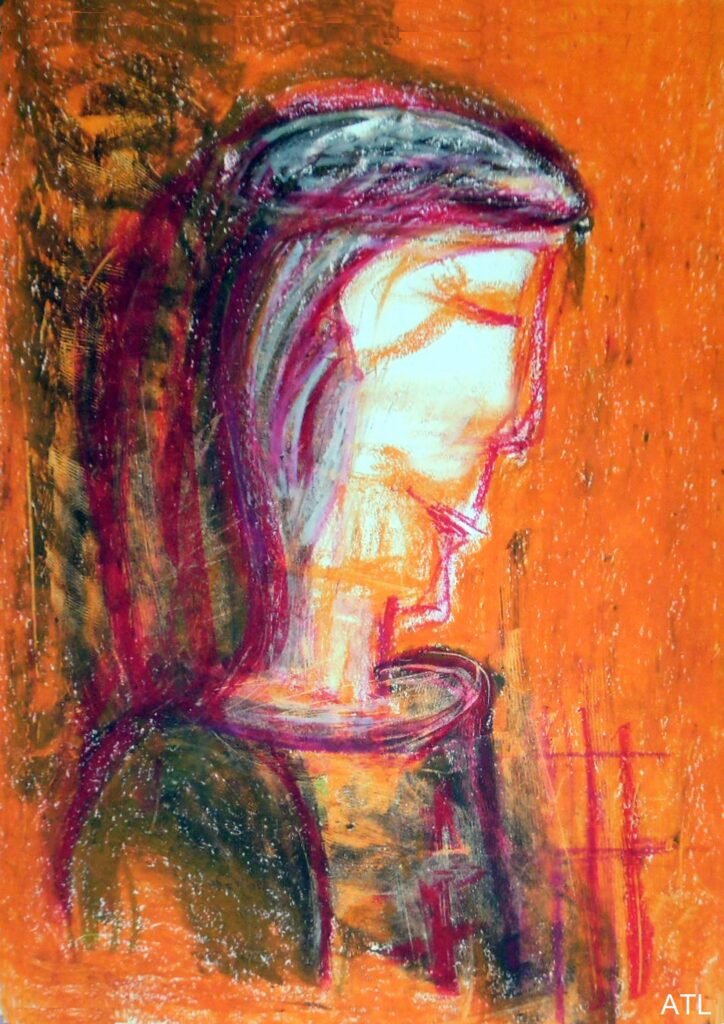
Question of Faith turns from romantic emotion toward spirituality and metaphysical reflection.
The work presents the profile of a man absorbed in a contemplative atmosphere. His expression suggests an individual engaged in an inward search, someone considering questions that move beyond the material world.
The figure’s association with a Franciscan monk introduces themes of simplicity, humility, and spiritual devotion. The barefoot and sparse Franciscan reality becomes a metaphor for an inner process of stripping away the distractions of the tangible world in order to approach the divine.
Laurita leaves open an important question: Is the figure searching for faith, or is he allowing himself to be found by faith?
This uncertainty gives the work its contemplative character. Faith is not presented simply as an established answer. Instead, it becomes a journey involving thought, choice, surrender, and discovery.
The subject also connects naturally with Laurita’s earlier literary engagement with St. Francis of Assisi. Her interest in Franciscan spirituality therefore extends across different stages of her creative career, demonstrating the continuity between her literary and visual work.
In the Flowers, the Wind
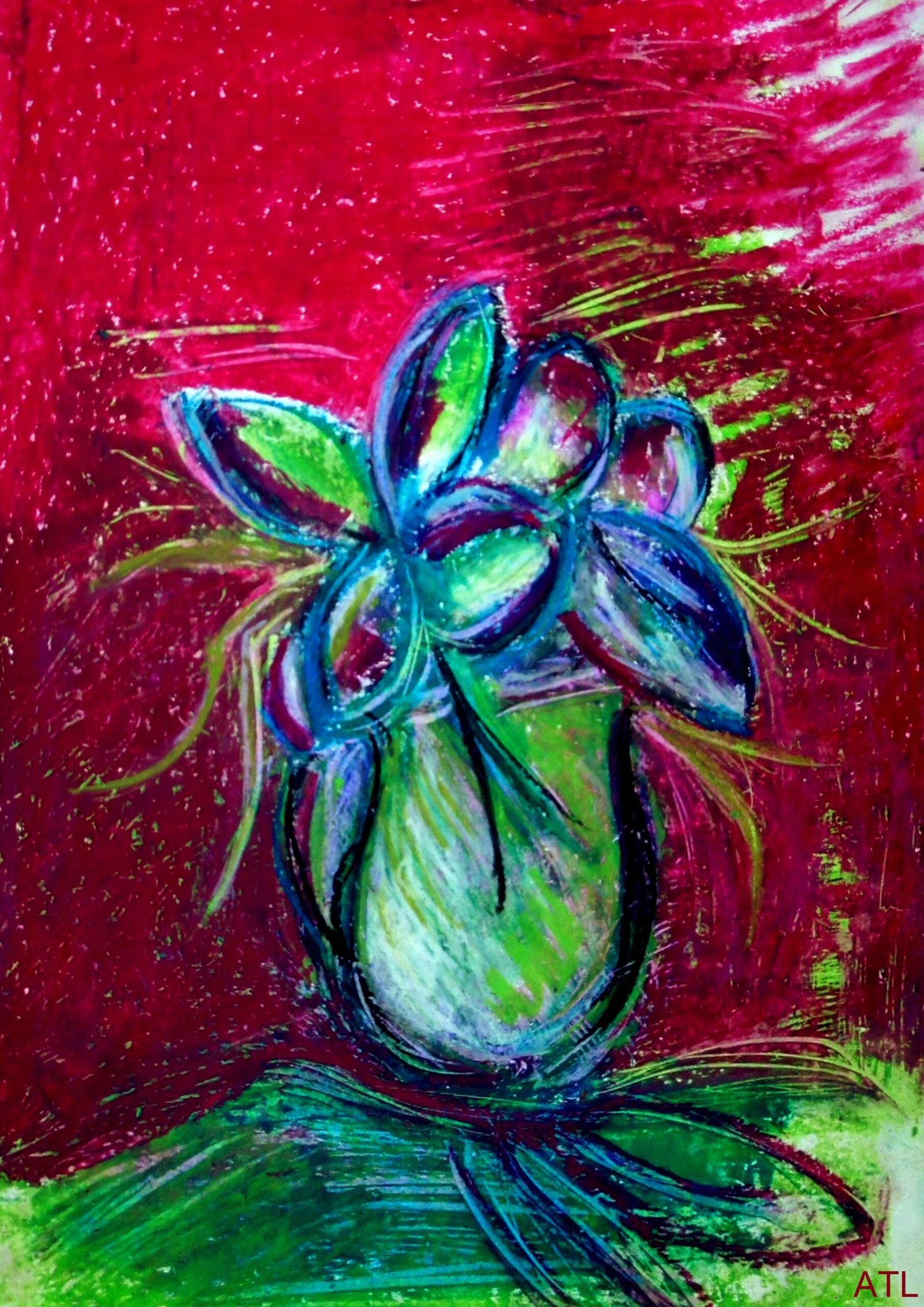
In the Flowers, the Wind, also titled Nei Fiori il Vento, revisits the traditional still-life genre through a highly imaginative perspective.
The work features flowers dominated by vivid red tones. However, these blossoms are not intended to represent a particular botanical species. They belong to the artist’s inner vision and exist primarily as expressive forms.
The flowers are arranged inside a vase, yet they seem almost ready to escape from it. Their stems create a subtle impression of movement, suggesting the presence of an invisible wind. The wind itself cannot be seen, but its imagined effect becomes perceptible through the composition.
Laurita’s use of pastel contributes to this atmosphere. The technique allows subtle variations in light and form to create a sense of movement across the background. Tiny fragments of light appear almost like traces of an unseen force.
The painting therefore becomes more than a still life. It becomes an exploration of energy, freedom, imagination, and the relationship between the visible and invisible worlds. The flowers remain physically still while suggesting movement, creating a poetic contradiction at the center of the composition.
Recognition Across the International Art World
Anna Teresa Laurita’s artistic development has been accompanied by an extensive record of international awards, exhibitions, publications, and critical recognition.
In 2022, she received the City of Barcelona Award at MEAM Barcelona, the Golden Palm Tree Trophy Award in Monte Carlo, the Italian Artists at the Louvre Award in Paris, and the Italian Artists in London Award.
Her achievements expanded considerably in 2023. Among the distinctions she received were the Leonardo Award, Artist of the Year Award in Brussels, participation in the USA Biennial Tour, the Golden Lion for Visual Arts Award, the Golden Gondola for Art International Award, the David di Michelangelo International Award, and the Claude Monet Oscar International Trophy. She also received first prize at the City of Saronno Biennial.
Her work appeared in Artisti ’23, accompanied by a critical note by Prof. Vittorio Sgarbi, and was included in the Modern Art Catalogue CAM No. 59. She also participated in the contemporary art collective exhibition To the Virgin Mary in Potenza.
Major Achievements in 2024 and 2025
Laurita continued to receive significant recognition in 2024. Her achievements included the Artist of the Year 2024 Award, the Lifetime Achievement Award Great Masters of the 20th Century, the Oscar for Creativity 2024, the Artist in History Award, the Gaudí Award, and the Creativity Award at the Ferrara Biennial.
Her international visibility was further strengthened through publication in VesAndRunways International Magazine Contest and World Art News Magazine in New York, where her work received a review by Jennifer McKay. She also received the World Art Award and Caravaggio Master Award.
In 2025, Laurita received the Giuseppe Mazzini Award at the Manzoni Theatre in Milan, the Premier Prize Artist 2025, and the Artist Award 2025 from Artnomad.com. Her work was again featured in World Art News Magazine, while she also appeared in The Heroine’s Journey by Peter de Kuster.
Further recognition included the Masters in Dubai Award 2025, the Oscar for Creativity 2025, the Statue of Liberty Award in New York, and the Golden Gondola Award 2025. Her participation in the exhibition Vasco Dilatatore by Carlo Amedeo Fusco added another dimension to her continuing exhibition history.
A Growing International Presence in 2026
Laurita’s artistic journey continues to expand in 2026 through new collaborations, exhibitions, awards, and publications.
Among her recent achievements are a collaboration and publication with the Archivio Monografico dell’Arte Italiana, the Artist in the World Award 2026, the Siren Award 2026, and gallery collaborations with Vendere Quadri and Singulart. She also received the Viareggio Award 2026.
Her international profile was highlighted through the ArtReviewUSA feature titled “Anna Teresa Laurita and the Poetic Force of Inner Vision.” She also participated in the 2026 Venice Biennale collective Salotto d’Artista at Anamenisis Art Gallery in Venice.
Another significant project is the international contemporary art collective Homage to St. Francis, curated by Angela Chiassi and presented in Rome at the Basilica of SS. Peter and Paul. The project creates a meaningful connection between Laurita’s long-standing interest in St. Francis and her contemporary visual practice.
The Continuity Between Literature and Art
Anna Teresa Laurita’s career demonstrates how different artistic disciplines can become interconnected over time. Her early experience as a poet and scholar did not disappear when she turned toward painting. Instead, literary sensibility became part of the way she approaches visual expression.
Her paintings often possess the qualities of poetry. They are suggestive rather than entirely explanatory, emotional rather than purely descriptive, and open to multiple interpretations.
Whether she is portraying love in Bell’Amore, spiritual searching in Question of Faith, or the invisible movement of nature in In the Flowers, the artist consistently searches for what exists beneath the surface of ordinary experience.
This connection between literature and painting helps explain the poetic atmosphere present throughout her work. Laurita does not simply paint subjects; she uses subjects as starting points for deeper emotional and philosophical exploration.
A Distinctive Voice in Contemporary Art
Anna Teresa Laurita has developed a distinctive artistic identity through her ability to transform universal experiences into deeply personal visual expressions. Her work moves between emotion and spirituality, memory and imagination, the visible and the invisible.
Her extensive record of international recognition demonstrates the growing visibility of her artistic practice, while her paintings reveal the more intimate foundation of that journey. Beneath the awards and exhibitions is an artist continually interested in understanding the human condition.
Her figures carry emotional histories, her flowers become symbols of inner movement, and her spiritual subjects invite contemplation. Across these different themes, Laurita maintains a consistent interest in the emotional forces that shape human existence.
Her journey from poetry to painting has therefore become more than a change of medium. It represents the evolution of one creative language into another. Through color, gesture, symbolism, and expressionist intensity, Anna Teresa Laurita continues to transform inner vision into visual experience, creating works that invite viewers not only to look, but also to feel and reflect.