

A curator recently shared with me a digital folder containing scanned slides of Alice Shaddle’s art, a lifetime of sculptures, collages, paintings, and installations, some of them representational, many others almost unclassifiably baroque. As I browsed the works most constructed from paper, latex, or vinyl two words kept recurring in the captions: whereabouts unknown. An unnamed 1960s sculpture of an overdressed little girl jutting forward with sinister pomp: whereabouts unknown. Camel (1969), a work that looks less like a desert animal than a two headed bird in the throes of a delirious molt: whereabouts unknown. Gardener (1974), a sculpture that resembles a carnivorous flower that’s both torpid and overfed: whereabouts unknown.
As much as it applies to particular works in her oeuvre, whereabouts unknown could just as well describe Shaddle’s own legacy when consulting histories of 20th-century Chicago art. But what might explain the near total omission of a figure who created a multitudinous body of work, taught at one of the city’s most revered art spaces for more than a half century, and died not all that long ago, in 2017, at the age of 88? Shaddle wasn’t included in “Art in Chicago: 1945–1995,” an important survey at the Museum of Contemporary Art Chicago in 1996, nor was she mentioned in the catalog. She was consigned to a literal footnote in Art in Chicago: A History from the Fire to Now, an otherwise encyclopedic account of the city’s art scene, published in 2018. And her work is almost never on view at any major hometown museum or gallery that I know of.
Shaddle’s mutability has proved double-edged: it made her singular, but also a bit difficult to categorize. Just when you think she’s a funky heiress to the Arts and Crafts movement, she turns out to be the architect of discreetly lyrical conceptual installations. Or when you reclaim her as a long-lost cousin of Pattern and Decoration, there she is, building boxes whose earthy interior textures are gnarled and elegiac.
That Shaddle was a woman likely did her career no favors. In 1954 she had what, in retrospect, was the professional misfortune to marry the artist and curator Don Baum, who in the 1960s and ’70s was the impresario of a freshly neurotic and caffeinated strain of Chicago art. The young artists who made up the groups known as the Hairy Who and the Imagists, whom Baum hyped in a series of dizzying exhibitions, remain Chicago’s most lionized art exports, and they made Baum’s fortunes as a local heavyweight who long overshadowed his wife. In a 2015 oral history interview with the Smithsonian, critic Dennis Adrian characterized Shaddle as “one of those riley, resentful ladies who [Baum] got all the attention, which at that time, you know, who’s going to compete with Don?” (The couple divorced in 1970, and, as of this writing, Shaddle merits no mention on Baum’s Wikipedia page, whereas he is mentioned on hers.)
A new exhibition at the Hyde Park Art Center in Chicago, where Shaddle taught for decades, aims to reintroduce her to the metropolis where she played a vibrant if still unsung role. The show, which opens March 23, is a welcome antidote to Baum boosterism and the art historical hangover of mythic ’70s Chicago. And under the title “Alice Shaddle: Fuller Circles,” it’s the first invitation to situate Shaddle on the continuum of Chicago modernism. Stylistically and temperamentally, she has long been considered a bit of an outlier, but she was always indebted to the strains of eccentricity and iconoclasm that distinguished the city’s artmaking.
Shaddle was born in the Chicago suburb of Hinsdale in 1928. She was raised as a “farm girl,” and her sensitivity to nature and seasonal rhythms is evident in many of her later cut-paper collages. Sore Tooth: Fall in the Woods (2001) conjures, with almost pointillist intensity, a smolder of autumnal foliage amid shaggy green undergrowth. Laughing Granny Hill (2001) presents a similar overstory of ruddy fall plumage that camouflages a wizened profile, a treatment of landscape as portraiture that Shaddle repeated elsewhere in her work. She earned a BFA from the School of the Art Institute of Chicago in 1954. Three years later, she and Baum bought the George Blossom House, a stout Colonial Revival mansion that Frank Lloyd Wright designed in 1892 one of the so called “bootleg houses” conceived in violation of Wright’s contract with fellow architect Louis Sullivan in the city’s Hyde Park neighborhood. The intricate patterns in the home’s stained glass windows inspired Shaddle, as is apparent in some of her later installations.

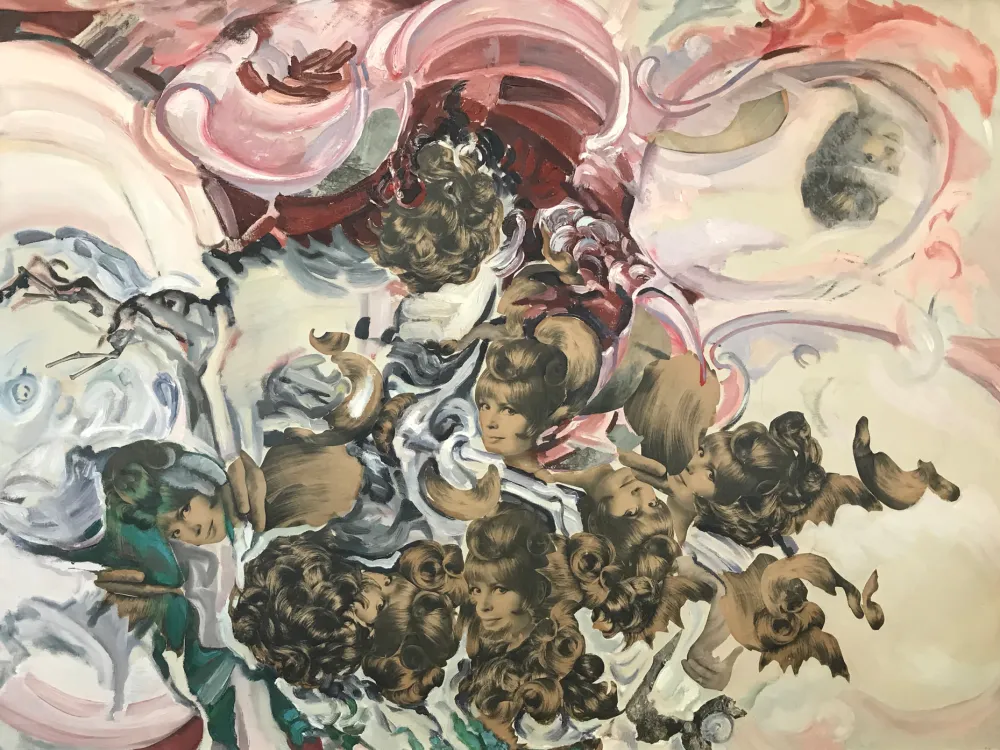
By the late 1950s she was teaching painting and drawing to children at the nearby Hyde Park Art Center, a small but mighty outpost that critic Franz Schulze described as “a slightly tattered, not for profit, store-front gallery a few blocks from the University of Chicago, or more than six miles from the main downtown gallery district.” (Baum was the Center’s exhibitions director.) Shaddle’s drawings and paintings from that period are technically adept but largely generic: flowers, still lifes, figure studies in charcoal, drab abstractions. There were, however, occasional quirky salvos that hinted at her wit and the formal virtuosity that defines her sculpture. A trio of works titled “Hollywood Image” (1962–63) features luscious eddies and hemorrhages of paint over which Shaddle collaged black and white images of starlets. In Hollywood Image No 2, an actress’s face repeated at least a half dozen times tumbles into a maelstrom of ringleted hairstyles, some of which are fragmented or partially erased. In Hollywood Image No 3, a vision of Marilyn Monroe abruptly surfaces from the surrounding squall of paint, a kind of apparition that seduces the eye to an erogenous upper corner.
These and other early works heralded Shaddle’s sculptures, in which figuration and abstraction reach a slippery truce. Many of the sculptures, made from papier mâché and Liquitex® adhesive, are as much about their own materiality as whatever they purport to represent. They are variously ruched and feathered, crimped and tucked, finessed into seemingly windswept geometries that look floral, flamelike, or manhandled depending on the angle. You puzzle over a sculpture’s tousled design, the riddle of its equilibrium, before you begin to wonder what it’s about.

In works such as Birthday Cake (1964), which portrays a pink confection with a missing slice and a fork on a plate, imagery from Shaddle’s underlying source material (a woman’s toothy face, a nativity scene, and carnal tableaux) peeks out from the swaddle, offering notquite subliminal messaging that feels as privately symbolic as it does narratively complicit. Intentionally or not, such sculptures subvert conventionally domestic subjects cakes, houseplants, flowers by rendering them at such a scale and with such tactility that they verge on perverse. (A 1967 sculpture, Cake Stand with Soft Dessert, offers fleshy mousse congealed atop a rococo base.)
Shaddle’s relationship to feminism, at least in her work, was subtle. In 1973 she was a founding member of Artemisia Gallery, a feminist co-op modeled on similar spaces in New York City (AIR Gallery) and Los Angeles (Womanspace). ARC Gallery, another such collective, opened that same year in Chicago. Both galleries were across the street from the Museum of Contemporary Art, which enabled them to stage counterprogramming that was inherently radical given such proximity to an institution with that degree of sway. For many female artists it was a moment of disavowal and critique, but the installations Shaddle created for Artemisia weren’t activist in tone. In Under the Snow (1978), she arranged 25 vellum circles on the floor in the shape of a Celtic cross. In Pond (1978), orbs blossomed from the floor, evoking lily pads or aquatic flowers. In other installations, she choreographed her paper constructions into configurations that had a poetic spatial economy. These works are meditative and transitory and about as far from the mania of the Hairy Who or the Imagists as imaginable.

In her final years, Shaddle deepened this ruminative approach. She exhibited new collages in 2007 made in the aftermath of September 11. These pieces, composed from hundreds or maybe thousands of fragments of cut vinyl, suggest landscapes and dreamy patterns, intimating the ambient dust and debris of the attack on the World Trade Center or, more philosophically, the atomization of a previously legible world. “They are accumulations,” Shaddle said of these vinyl shards.
Accumulations is an apt term for her entire body of work. Paper and vinyl and other castoffs gradually cohere into something distinct and meaningful. Similarly, when you look at the entirety of Shaddle’s long career, you see that her idiosyncrasy and uniqueness consist in embellishing ambiguity. Her work wavers between figuration and abstraction without committing entirely to either. Despite the dynamism of much of her art, particularly her sculptures, there is also a fugitive stillness, like a wave at the moment it has crested and not yet divulged the mysteries beneath.