

Adamo Macri’s artistic practice is rooted in transformation. Working across sculpture, photography, painting, video, performance, and drawing, Macri approaches art as an evolving process rather than a fixed category. His projects frequently move between mediums, allowing an idea that begins as a sculptural object to develop into a performance and eventually exist through photographs or video stills. This fluid movement between forms reflects his broader interest in the relationship between materials, the body, identity, and the essence of an artwork.
Rather than allowing medium to determine the meaning of a work, Macri places the concept at the center of his practice. The resulting works often feel like fragments of a larger narrative, with each project presenting a particular moment within an ongoing investigation. This approach becomes especially compelling in his Concrete Facade series, where the human figure encounters architectural structures, repetition, ornamentation, and artificial environments.
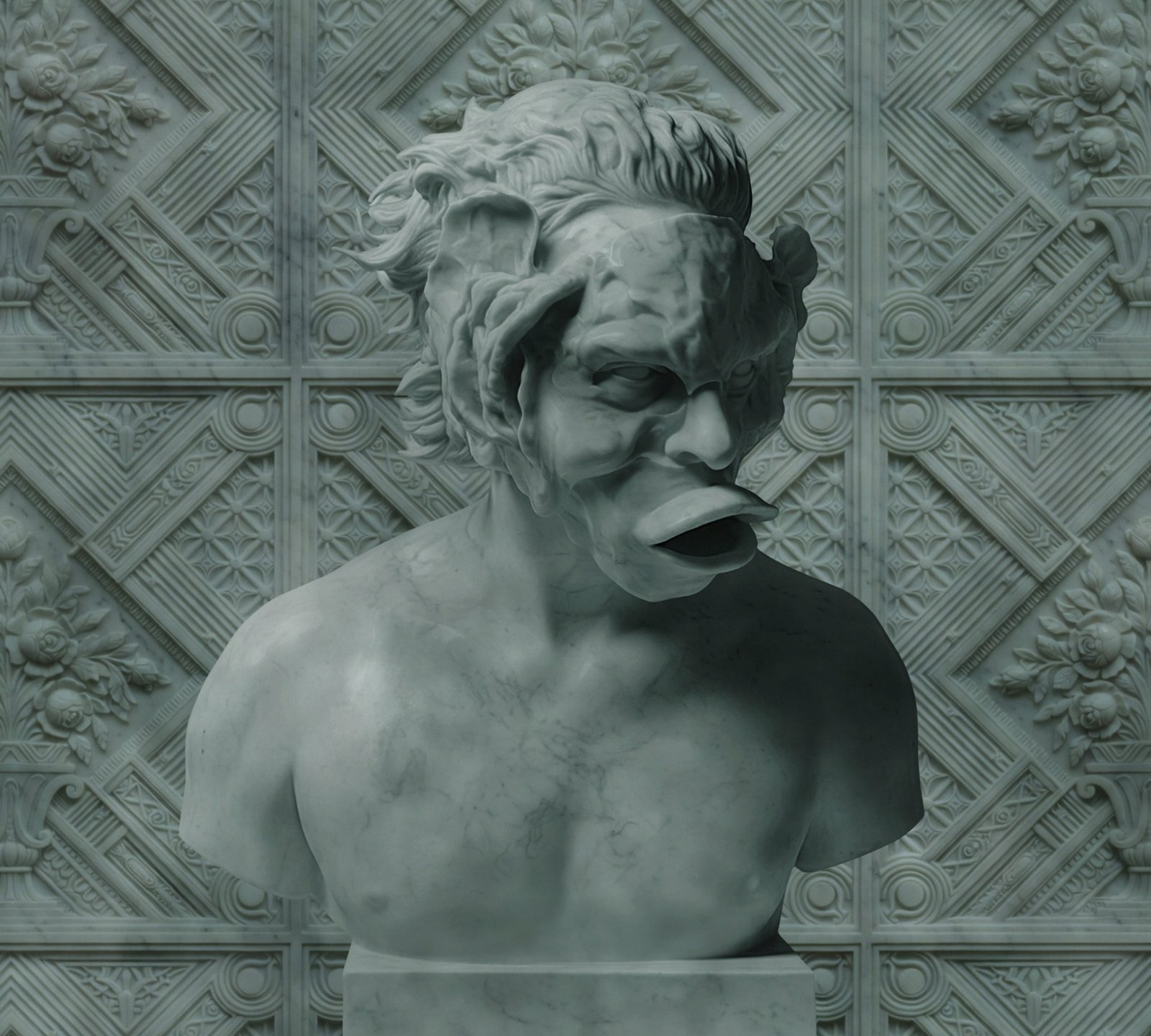
With Concrete Facade III (2026), Macri takes this exploration in a distinctly monstrous direction. The work presents an elaborate masked character whose exaggerated features and imposing sculptural presence appear to emerge from an environment defined by architectural repetition and ceremonial order. Cast in a desaturated mint-green cement hue, the figure seems simultaneously ancient and contemporary, resembling a fragment from an imagined monument belonging to a civilization that never fully existed.
A Human Figure Transformed
At the center of Concrete Facade III is a figure with an unmistakably human body but an ambiguous and unsettling face. The character’s mask transforms its identity, replacing recognizable human features with something more distorted and unfamiliar. An enlarged mouth, pointed forms, and exaggerated facial features give the figure a monstrous quality, but its presence suggests more than theatrical horror.
The mask can be understood as a visual representation of the tension between the individual and the identity constructed around them. It does not simply hide the face. Instead, it creates another identity altogether. The figure becomes a person, object, character, and persona at the same time.
This ambiguity is central to Macri’s treatment of the body. The human form becomes a site where different identities can overlap. What appears to be a disguise may also represent an alternative self, a protective surface, or an external manifestation of something normally hidden. The distinction between an authentic identity and a performed identity becomes increasingly difficult to maintain because the mask appears almost inseparable from the body itself.
Architecture, Order, and Disruption
The figure cannot be separated from the architectural environment surrounding it. Behind the character, a patterned surface establishes a rigid visual order through repeated geometric structures and ornamental motifs. This sense of symmetry and repetition creates a strong contrast with the irregularity of the masked figure.
The architecture suggests discipline, structure, repetition, and control. The character introduces distortion, instinct, excess, and unpredictability. Their coexistence creates a tension between the individual and the environment that contains them.
Rather than simply presenting the figure against an architectural backdrop, Macri makes the two appear interconnected. The body seems to have been shaped by its surroundings, yet it also appears capable of disrupting the order around it. The character is simultaneously contained by the architecture and resistant to it.
This relationship gives the work much of its psychological tension. The architecture can be interpreted as an inherited system of forms, expectations, and cultural structures. Within that system, the figure becomes an interruption. Yet its elaborate mask and sculptural appearance echo the ornament surrounding it, suggesting that the character may also be a product of the very environment it appears to challenge.
The Mask as a Symbol of Identity
The monstrous mask in Concrete Facade III functions as more than an unusual sculptural detail. It becomes a language through which Macri explores transformation and unstable identity.
The figure’s distorted face can evoke the repressed, the instinctive, the vulnerable, or the unknown. Its exaggerated features make the character appear threatening, but the work does not reduce the monstrous to something purely negative. Instead, monstrosity becomes a state of transformation.
The character appears caught between recognizable humanity and something else. It is neither completely human nor entirely alien. This in-between quality makes the figure compelling because it reflects the uncertainty involved in changing identities. The mask conceals, but it also reveals. By hiding the ordinary human face, it exposes another dimension of the subject.
The figure therefore raises questions about whether identity is something inherent or something constructed. If a mask becomes integrated with the body, where does the original self end and the performed self begin?
The Relic-Like Quality of Mint Green
Colour plays an important role in shaping the atmosphere of the work. The desaturated mint-green tone moves away from natural flesh colours and the warmer hues traditionally associated with figurative sculpture. Instead, the surface evokes oxidized metal, aged cement, painted plaster, or a weathered architectural object.
This treatment gives the character the appearance of a relic. It feels as though the figure might have been excavated from an unfamiliar civilization, carrying the visual traces of a culture whose symbols have survived while their original meanings have disappeared.
At the same time, the cool and muted colour prevents the figure from becoming simply frightening. Its strange features remain imposing, but the subdued surface introduces a poetic distance. The character becomes both intimidating and vulnerable, as though it is itself undergoing a process of decay, transformation, or rebirth.
The figure consequently appears suspended between different states: human and object, present and ancient, living body and architectural fragment.
The Façade Made Flesh
One of the most significant ideas within Concrete Facade III is the relationship between the character and the surrounding façade. The figure does not appear to be an independent object merely positioned in front of an architectural surface. Instead, it seems to have emerged from the same visual and cultural system.
In this sense, the character can be read as the façade made flesh.
The surrounding architecture represents repetition, ornament, control, and artificial construction. The masked figure embodies the psychological and bodily consequences of these forces. Its grotesque appearance becomes a physical manifestation of an environment that has attempted to impose order on the individual.
This creates an important duality. The character is both intruder and product. It disrupts the architectural pattern while simultaneously reflecting it. Its elaborate appearance echoes the surrounding ornament, suggesting that the monstrous may not exist outside the system but may instead be generated by it.
Macri’s work therefore avoids a simple opposition between human and environment. Instead, the two appear to continuously produce one another.
Between Beauty and Grotesquerie
The visual language of Concrete Facade III also brings beauty and grotesquerie into close proximity. The elaborate sculptural treatment has a decorative quality, while the distorted face introduces discomfort. The architectural repetition creates visual harmony, while the figure disrupts that harmony.
These qualities are not presented as simple opposites. They coexist within the same object and environment.
This combination reflects Macri’s wider interest in the unstable nature of artistic forms. A sculpture can become a performance. A performance can become an image. A body can become a constructed persona. An architectural façade can become a psychological landscape.
The artwork’s meaning therefore remains open and shifting rather than settling into a single interpretation.
An Evolving Narrative of Identity
Concrete Facade III continues Adamo Macri’s investigation into the body as a site of construction, concealment, and metamorphosis. The masked character exists between categories, appearing simultaneously as person and object, face and mask, human form and architectural ornament.
Its elaborate appearance carries both seduction and discomfort. The work invites viewers to consider how identities are formed, how they are performed, and how external structures can influence the way individuals understand themselves.
As the third chapter of the Concrete Facade series, the work expands the idea of the façade beyond a monumental architectural surface. Here, the façade becomes an environment in which identity is manufactured, disguised, and continually transformed. The masked character is its most unsettling inhabitant, a figure that embodies the uncertain boundary between what is hidden within the human subject and what is produced by the structures surrounding it.
Through this combination of sculpture, architecture, symbolism, and psychological ambiguity, Macri transforms Concrete Facade III into more than an image of a monstrous figure. It becomes an exploration of transformation itself, asking viewers to consider whether the monstrous is something concealed beneath the human exterior or something created through the systems by which people attempt to define, organize, and construct identity.
Discover More of Adamo Macri’s Work
To explore more of Adamo Macri’s artistic practice, projects, and visual explorations, visit his official blog: adamomacri.blogspot.com.