

Oenone Hammersley’s paintings occupy a productive tension between seduction and disturbance. At first encounter, their saturated chromatic fields, sweeping forms, and expansive compositions appear to offer an exuberant vision of the tropical world. Look longer, however, and the paintings begin to feel less like straightforward celebrations of landscape than unstable environments: places in which water, vegetation, geological forms, and atmospheric effects are continually shifting. Hammersley uses the visual pleasures of painting to draw attention to what is increasingly precarious.
Born in England in 1957 and now based in Florida, Hammersley has developed a practice informed by theatre design, extensive travel, and a sustained engagement with ecological subjects. Journeys through Southeast Asia, India, Africa, and Latin America have supplied a vast reservoir of visual impressions, but their significance within her work extends beyond recollection. They have contributed to an approach to composition that is fundamentally theatrical. Forms enter and recede, planes overlap, and color operates almost scenographically, directing the eye through the pictorial field.
This sense of staging is particularly revealing when considered alongside Hammersley’s environmental concerns. Rather than treating the landscape as a stable backdrop, she constructs it as a dynamic system. Her paintings suggest environments caught between equilibrium and disruption, where apparently organic rhythms can also register as signs of instability.
Staging the Landscape
Hammersley’s background in theatre design provides an important key to understanding her spatial strategies. Theatre depends upon the orchestration of attention: a stage is not merely occupied but composed, with scale, contrast, movement, and intervals determining how an audience experiences a scene. Hammersley brings a comparable sensibility to the painted surface.
Her landscapes rarely settle into conventional perspectival recession. Instead, spatial depth is generated through overlapping contours, sweeping gestures, abrupt chromatic transitions, and passages that alternately advance toward and withdraw from the viewer. The resulting spaces feel constructed rather than simply observed. They resemble environments remembered through sensation rather than mapped through geography.
Her travels have intensified this tendency. Exposure to radically different ecosystems and visual cultures has given her a broad vocabulary of forms, but she does not attempt ethnographic or topographical description. Instead, fragments of place are translated into a more fluid pictorial language. A pool becomes a field of turquoise; vegetation becomes a series of curving masses; geological formations are reduced to rhythmic structures. The specific location dissolves, leaving an imagined ecosystem assembled from memory, observation, and invention.
Water as Image and Gesture
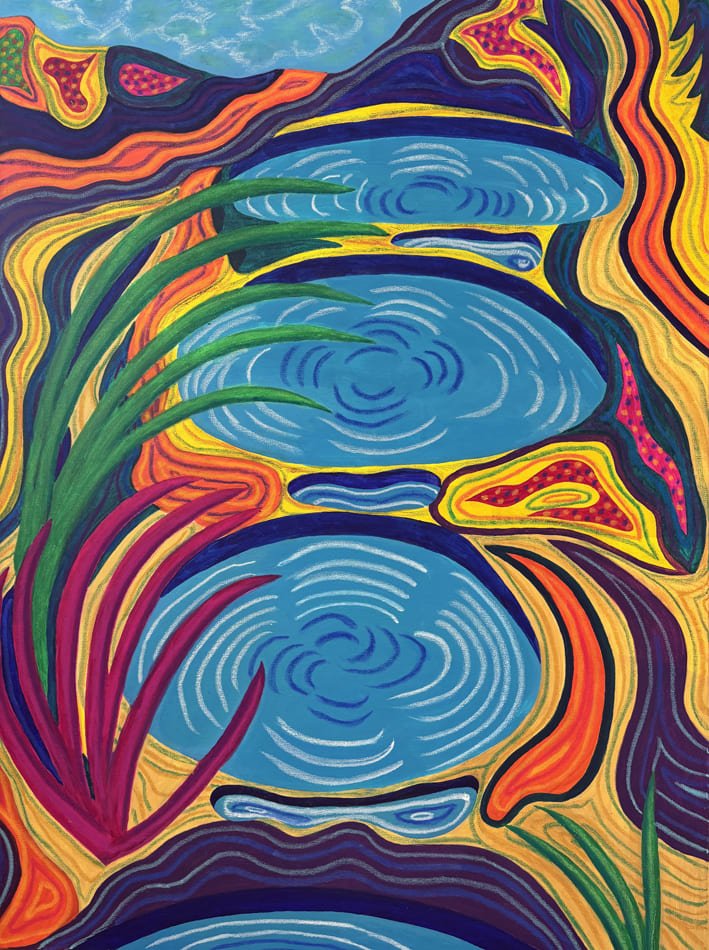
Tropical Landscape with Rock Pools, a 40-by-30-inch mixed-media work executed in acrylic with oil pastel applied over the acrylic, offers a compelling example of Hammersley’s approach to abstraction.
Three turquoise pools move through an imagined landscape, enclosed by sweeping green forms and interrupted by bands of orange, yellow, magenta, and deep violet. Pale curved marks traverse the water, suggesting ripples and currents, while overlapping contours establish a rhythm that prevents the composition from settling into a static view.
The painting’s material construction is integral to this effect. Hammersley works directly with acrylic, using oil pastel over the painted surface to introduce a more immediate, gestural register. The contrast between the broader painted areas and the finer marks creates visual variation, allowing the eye to move between expansive fields of color and the details that articulate their movement.
Water functions here as both subject and compositional force. The curved marks animate the turquoise pools, while the surrounding green forms frame the water without fully containing it. Rather than reproducing a specific location, Hammersley constructs an imagined ecosystem in which organic shapes, chromatic contrasts, and directional gestures create a sense of continuous movement.
Abstraction and Ecological Fragility
Hammersley’s ecological concerns include deforestation, ocean pollution, and overfishing, and she supports conservation organizations through regular donations. Yet the significance of her work lies less in illustrating these issues literally than in finding a formal language capable of communicating their underlying instability.
Deforestation, for instance, is difficult to represent through a single descriptive image without reducing a complex ecological process to a symbol. Hammersley instead destabilizes pictorial space. Sweeping forms crowd the composition; boundaries between organic structures become uncertain; and layers compete for visual territory. The landscape becomes something constructed and potentially disrupted.
Her treatment of aquatic space operates similarly. The pools in Tropical Landscape with Rock Pools are not passive patches of blue inserted into a landscape. Their curved marks and fluid trajectories give them agency within the composition. Water appears to move through the painting, while the surrounding forms seem to accommodate, contain, or compete with that movement. The image consequently evokes an ecosystem as a network of relationships rather than a collection of separate objects.
This is where Hammersley’s abstraction becomes conceptually useful. Ecological fragility is rarely dramatic at the moment it begins. It is often cumulative: habitats are altered, waters become contaminated, populations decline, and familiar environments gradually acquire unfamiliar conditions. Her layered compositions evoke something of this accumulation. Each painted area, contour, and gestural mark contributes another register to an environment whose apparent coherence depends upon the relationship between its parts.
Chromatic Seduction and Unease
Hammersley does not rely on muted palettes to convey ecological concern. Instead, chromatic intensity becomes part of the argument.
The turquoise of the rock pools establishes an immediate visual attraction. Against it, warm oranges and yellows generate sharp complementary tension, while magenta and deep violet complicate the palette further. These contrasts produce an almost sensory excess. The eye is encouraged to move continually across the surface.
That seduction is significant. Hammersley understands that viewers often encounter environmental degradation through abstraction: statistics, distant images, scientific reports, or familiar warnings. Painting can operate differently. It can make the viewer dwell on an environment before asking them to consider its vulnerability.
The tension between allure and apprehension consequently becomes one of the defining characteristics of her practice. The paintings invite immersion, but they do not permit complete comfort. Their surfaces are too active, their spaces too unsettled, their forms too resistant to fixed interpretation.
From Observation to Imagination
Hammersley’s work ultimately occupies a space between observed landscape and gestural abstraction. Her paintings retain enough references to water, vegetation, and terrain to establish an ecological premise, while their formal transformations allow those references to become metaphors for a changing world.
This approach reflects her broader artistic statement: color and illumination are employed to draw attention to a vanishing wilderness and to encourage viewers to consider both the rawness of the world around them and the consequences of human intervention. Yet the paintings are strongest when this idea is allowed to emerge through their material and spatial decisions rather than being stated outright.
Tropical Landscape with Rock Pools demonstrates this strategy with particular clarity. Its pools suggest water without becoming literal representations; its vegetation becomes rhythm; its landscape becomes an unstable stage. Through the interplay of hand-painted acrylic and oil pastel, Hammersley establishes a visual language in which gesture, chromatic contrast, and shifting contours evoke an environment that resists fixed interpretation.
Hammersley’s paintings have been exhibited at galleries and art fairs in New York, London, Miami, Washington, DC, Paris, Los Angeles, and Seattle, and are held in private and public collections internationally. Her upcoming exhibitions include Art Miami in December and Palm Beach Contemporary in March, offering further opportunities for audiences and collectors to engage with her work.
What distinguishes Hammersley’s practice is ultimately not the straightforward assertion that the environment should be protected, but the way she makes ecological uncertainty into a problem of painting itself. Her landscapes are constructed, layered, and disrupted through the interplay of form, gesture, and chromatic contrast. They are places that seem at once lush and precarious, inviting and unsettled.
In that instability lies their most compelling proposition: the landscape is not a fixed image waiting to be admired. It is a living system, subject to continual transformation, and painting can make that instability visible.