

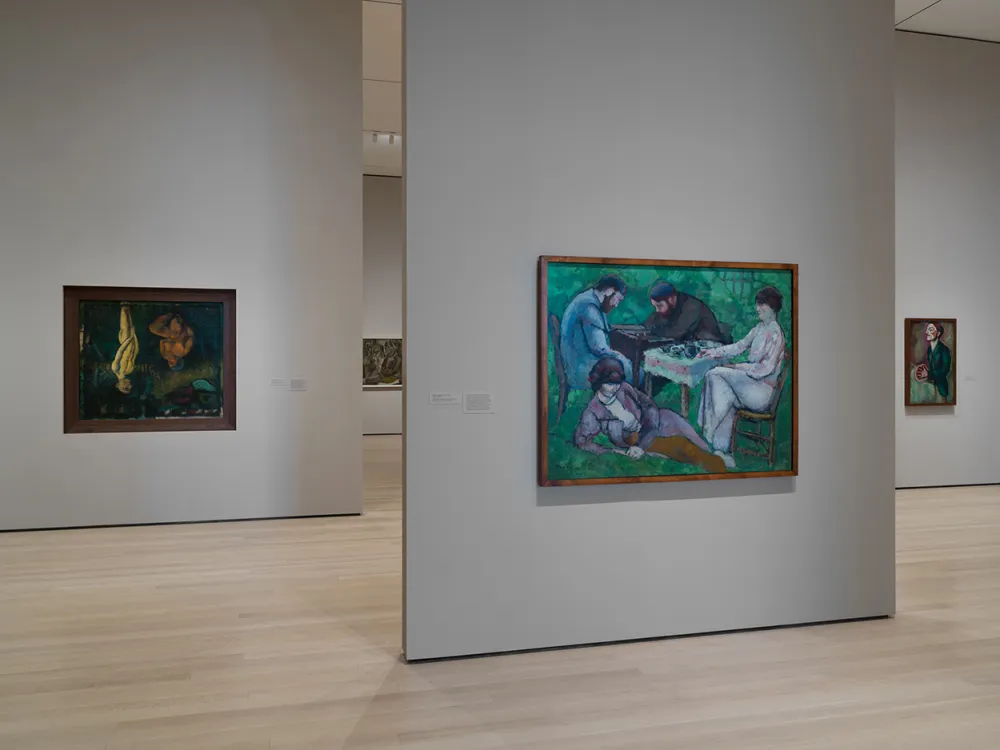
The first rooms of MoMA’s Marcel Duchamp retrospective almost dare the visitor to find in his early paintings some hint of the artist’s future travesty of those mediums. The picture with which the show opens a placid scene of the artist’s two older brothers, Gaston (Jacques Villon) and Raymond, engrossed in a game of chess telegraphs Duchamp’s future, temporary abandonment of art in favor of the game, which, he avowed, “could not be commercialized.”
Look closely and there are more hints still if you squint. The ink and watercolor Woman Hack Driver (1907), distilling its subject to a mere chassis, likewise foretells his eventual mechanization of human embodiment (and, conversely, his eroticization of machinic apparatuses). Even the late Symbolist Paradise (Adam and Eve) (1910 –11) seems to hint at its scene’s afterlife in a Man Ray photograph, wherein Duchamp and Bronia Perlmutter reenact Lucas Cranach’s painting in Francis Picabia’s ballet Relâche (1924).
Duchamp’s prominence as the inventor of the readymade (the entire range appears duly displayed) has often eclipsed his aesthetic beginnings as if his consequence for conceptual art had arrived out of thin air. Featuring 300 works in a range of media, this first survey of his oeuvre since 1973 allows connections to percolate among disparate works from different periods, including the extensive reproductions and facsimiles which occupied the artist’s later years.
Yet Duchamp did not cross over immediately and irreversibly into the province of mere ideas. His first readymade came by way of a painting: Pharmacy (1914) consists of a cheap, commercially produced print of a snow-covered landscape painted by a Swiss artist named Sophie von Niederhäusern. Atop the reproduction, Duchamp daubed two dots of red and green in gouache, evidently inspired by snow globes sold in French pharmacies. It is this intervention as much as the image upon which it plays—that comprised the first readymade.

Meanwhile, the painting Landscape (1911), with its saturated teal and orange pools, betrays no dawning sense of reflexive mordancy, no self-consciousness regarding its own support. The kitschy solemnity of the figures foregrounded in Baptism (1911) perhaps gives the lie to their earnestness. Yet the range of Duchamp’s early work on canvas reveals a sincere investment in painting. If the Portrait of the Artist’s Father (1910) evinces what the artist called “my cult of Cezanne,” its black outlines and paler washes of color form just one example of his rapidly evolving methods. By 1911 he had deftly assimilated Cubism’s lessons, with the kaleidoscopic whirl of Portrait (Dulcinea) anticipating the hard-edged figure studies on which Duchamp would stake a new idiom.
Present here are not simply the iconic Nude Descending a Staircase (1911–12) and affiliated images, but their caricature by a perplexed American press. Works like Bride (1912), The Passage from Virgin to Bride (1912), and The King and Queen Surrounded by Swift Nudes (1913) flesh out the mix of handiwork and increasingly cerebral procedures that characterized Duchamp’s work during these fertile years before the Great War. These images evince a mounting desire to “recreate ideas” on canvas; yet they also take clear, manual pains to reproduce corporeal presence (and its enigmatic surrogates) in visual terms.
The artist’s mechanomorphic experiments reached their denouement in The Bride Stripped Bare by Her Bachelors, Even, otherwise known as The Large Glass (1915–23). Too fragile to travel, the original remains at the Philadelphia Museum of Art, where the show travels next. Instead, we are treated to a virtual assembly line of its pictorial and diagrammatic gestation, as steeped in philosophy and optics as it was labor-intensive.
A display of the full spectrum of Duchamp’s readymades includes original studio photographs that provide welcome context to their conception and development, helpful reminders of the vitality of process to his oeuvre. When The Large Glass accumulated layers of dust in his studio, this became the basis for a new work unto itself (Man Ray’s photograph Dust Breeding, 1920). When the work itself cracked after its 1926 exhibition in Brooklyn, Duchamp declined to repair it.
A series of preparatory “Chocolate Grinder” paintings distills Duchamp’s complex ideas regarding “bachelorhood” and sexual politics to spare apparatuses. Yet the care with which he applied actual threads to the circular drums in one such painting betrays meticulous attention to the “optical” and artisanal matters that he would soon ceremoniously renounce. Thread would also notably serve in detaching the artist’s work from the teleological operations of his hand. For the landmark 3 Standard Stoppages (1913–14) Duchamp famously dropped a one-meter-long thread on the ground and traced its (aleatory) contours on canvas, converting these in turn into wooden measuring units. This active courting of chance would prove integral to Dada activity both in Paris and New York, where Duchamp came to collaborate with Man Ray, Katherine Dreier, and other American artists during World War I. It was there in 1917 that he debuted the infamous Fountain, an inverted urinal signed “R. Mutt,” which more than a century later still galvanizes discourse around the boundaries between aesthetics and objecthood.

Rarely has an exhibition’s installation shifted so dramatically from vertical hanging to horizontal display—a reorientation that reflects Duchamp’s eventual disavowal of painting. To be sure, images and objects still hang on the wall as the show progresses chronologically. But they span everything from Man Ray’s labels for the gender bending Belle Haleine perfume, for which Duchamp modeled, to photos of the artist in his equally seductive guise as Rrose Sélavy, and still more pictures showing his head and face lathered in soap. Readymades hang from the ceiling and upright screens reveal Duchamp’s forays into film, such as Anemic Cinema (1926), with the related, kinetic Rotary Demisphere (Precision Optics) (1925) and Rotoreliefs (1935) displayed nearby. The mesmerizing formal aspects of these works characteristically contain erotic allusions, while his spiral disks of the 1920s play upon language and puns as much visual effects.
Wisely, the catalog essays focus less on the works themselves than on their consequence for museological and institutional matters (its meticulous and illustrated timeline will serve as a touchstone for decades). Indeed, if by the 1930s Duchamp had set “art” aside in favor of chess, his Green Box (1934) contained nearly a hundred facsimiles of his notes and drawings for The Large Glass and other works—a recapitulation that anticipated the more condensed reproductions of his work circulated in the “portable museum,” Box in a Valise (1941).
In the catalog’s preface, the curators note a “general lack of firsthand access to the full range of [Duchamp’s] work.” But precisely of what might his “work” be said to consist? Do its fitfully re issued readymades to say nothing of its suitcase-sized dissemination, photographic reproductions, and simply verbal articulations not underscore how Duchamp revised the very idea of what a “work” is at all? If his oeuvre undeniably requires a certain intellectual initiation into its significance (on top of MoMA’s $30 entry fee), did he not democratize aesthetics in ways that render “firsthand access” at least partially obsolete? On the whole, the exhibition is a treat and a success, yet like Duchamp’s readymades it leaves the visitor with more questions than answers.