

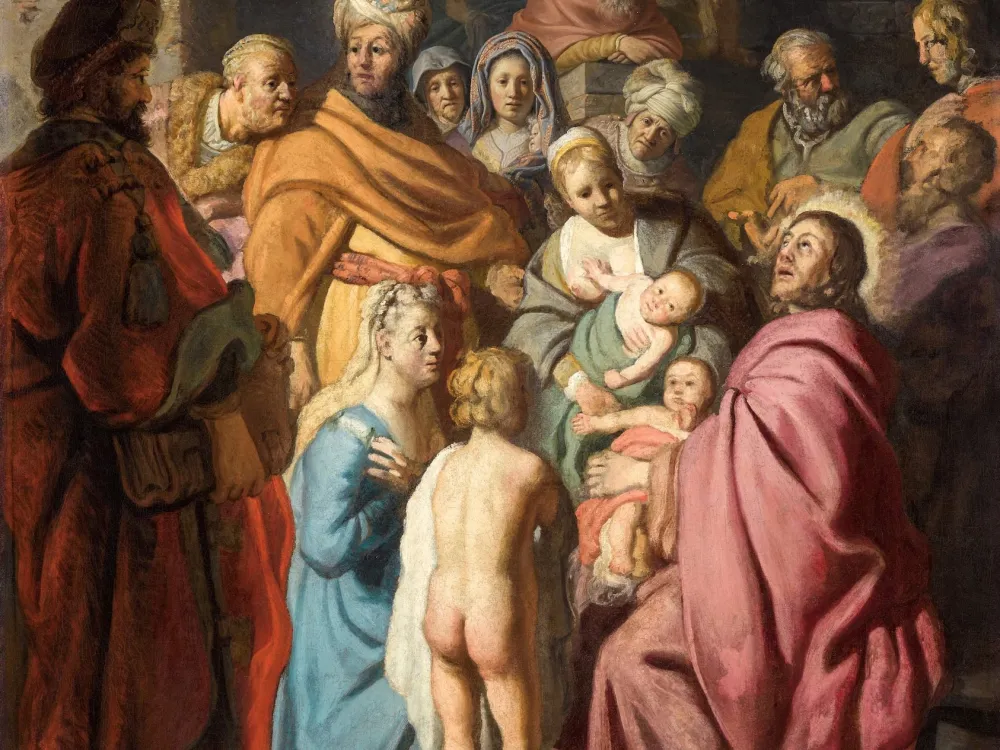
Sotheby’s London will offer a restored early painting by Dutch master Rembrandt van Rijn that was discovered over a decade ago and reattributed to the artist. The painting has undergone extensive restoration, removing overpainting by other hands and revealing imagery that, experts say, may have articulated a message of religious tolerance in a moment of social tensions arising partly from a refugee crisis.
Let The Little Children Come Unto Me (begun in 1627) comes to auction July 1 and is estimated at £8–12 million ($10.6–$15.9 million). The 40-inch-high painting is, per the house, the only known rendition of the subject by the Dutchman. The seller bought it at Cologne auction house Lempertz in 2014, when it was attributed to an unknown 17th-century Netherlandish artist, for just €1.5 million ($1.7 million at today’s exchange rate). It was discovered by Amsterdam dealer Jan Six, a direct descendant of his namesake, the subject of a 1654 portrait by the artist, and it has been authenticated by experts Christopher Brown and Ernst van de Wetering.
If it makes its high estimate, it will be his sixth-highest price at auction (without correcting for inflation). The artist’s record stands at $33.3 million, set at Christie’s London in 2009 with Portrait of a Man with Arms Akimbo (1658). Selling for $15.9 million would place the painting just behind the $17.9 million paid in February at Sotheby’s New York (the highest price ever paid for a drawing by the artist) for Young Lion Resting (ca. 1638–42), from the collection of American-Franco precious metals mogul, philanthropist, and conservationist Thomas S. Kaplan.
Rembrandt left the foreground unfinished for unknown reasons; it was then completed later (rather crudely, says the house) by an unidentified contemporary or follower. Those additions were removed by restorers over the last decade.

The restoration reveals changes by the unknown subsequent artist to many of the scene’s figures. The naked back of a child front and center was painted over with clothing; a young girl was painted over with a grown woman; an infant in Christ’s arms was altered to be an older child; and Christ’s own face, hair and beard were altered.
But the house notes one possibly very meaningful change in particular to one of the figures near the canvas’s center left: a man who, before restoration, was seen sporting white hair and beard, in a Dutch cap, and gesturing toward the central figures, is now revealed not only to be without the white hair and beard but also to have been wearing a turban and a more Eastern looking costume.
The presence of a man who may have been a Muslim suggests that, in a canvas that also contains Jews and Christians, the Dutch artist was articulating a message of tolerance. Having mixed roots himself—his mother came from a Catholic background while his father was Protestant Rembrandt was likely especially sensitive to sectarian conflict that was raging at the time. A wave of refugees created by the Thirty Years’ War, stemming from religious differences and one of the most destructive conflicts in European history, was just then entering the city of Leiden, leading to social tensions; Rembrandt was associated with the Remonstrants, who advocated for tolerance.
“In 1627, when Rembrandt started this painting, Leiden was undergoing an extraordinary humanitarian crisis,” as art historian Andrew Graham-Dixon is quoted in press materials. “The Thirty Years’ War was at its height, and… hundreds of thousands of people were flooding into the Dutch Republic as refugees.” Leiden is estimated to have taken in approximately 10,000 refugees in 1626 alone, he points out.

“Now, when Rembrandt is painting this, he’s painting this crowded scene of Christ welcoming children, welcoming families,” Graham-Dixon continues. “This was very controversial at the time. There were people in Leiden who didn’t want to welcome them. But, what we can tell from this painting is that Rembrandt is on the side of humanitarian relief. He’s on the side of the suffering children.”
Graham-Dixon concludes, “So, this is more than just a painting. I think it’s a statement of Rembrandt’s moral position of his sympathy. Is there any painter in history more sympathetic to the human condition than Rembrandt? Yes, he’s young, yes, it’s unfinished, but already looking into his eyes, looking into the urgency of his expression, I think we can feel that here Rembrandt says yes to life, yes to helping these people. Yes, I’m on Christ’s side when he says, ‘Suffer the Little Children.’”
While it is nominally a rendition of a Biblical scene, it also is a highly personal work, notes the auctioneer, including depictions of his mother and father and, possibly, also his godparents and godsister. The canvas dates to 1627, when the artist had returned to his native city of Leiden after serving an apprenticeship with leading Amsterdam artist Pieter Lastman. Sotheby’s suggests that he may have been inspired to include his parents, who had hoped he would enter a more secure career in law, administration, or the church, as a way to thank them for their support and to indicate to them that their investment in his career had paid off. (Ironically, the artist famously filed for insolvency in 1656, having overspent and made unwise investments even as his international renown increased.)
Rembrandt’s mother, Cornelia Willemsdr. Van Zoutbrouck, appears just to the right of the man in the turban, while his father, Harmen Gerritsz. Van Rijn, appears above and behind her, in the shadows. The artist, his face highly recognizable from his numerous self-portraits, appears at the top of the painting, draped in white, looking out at the viewer. The elderly man next to Rembrandt and the androgynous figure with the fur hat beneath, says the house, may be Rembrandt’s godparents, while the young woman wearing embroidered headgear holding an infant is most likely a member of Rembrandt’s family or household, possibly his orphaned god-sister.
The house says the painting may have been the one that was recorded in two contemporary Dutch collections. It may have first been owned by wealthy bachelor Floris Soop, possibly the man who appears in a 1654 painting by the artist now hanging in New York’s Metropolitan Museum of Art. A painting fitting this one’s description appeared in an inventory of his collection and then went to his son Wilhelmus Scriverius, who later sold a number of paintings at auction, including two examples by Rembrandt.
Since its reattribution, it appeared in the exhibition “Young Rembrandt,” which appeared at the Museum De Lakenhal in Leiden and at Oxford’s Ashmolean Museum in 2019–20.