


There is a particular kind of artist who does not need an exotic subject to make an exotic picture. Jane Gottlieb belongs to that category. For more than three decades, she has pointed her camera at the world most of us walk past without noticing and returned with images that feel closer to invention than documentation. A stack of fruit, a wall of neon, the sweep of a building’s steel skin: in her hands, the familiar becomes strange again, and the strange becomes beautiful.
An Eye Trained on the Overlooked
Gottlieb’s photographs rarely announce themselves as reportage. They are built, layered, and considered, even when their source material is something as mundane as a storefront or a stretch of sky. What distinguishes her practice is not simply a talent for composition but a persistent curiosity about how color and light can be pushed past their ordinary function. Where a documentary photographer might wait for the “decisive moment,” Gottlieb often seems to be asking a different question: what happens if this moment is allowed to become more than itself?
That question has occupied her for over thirty years, long enough for her visual language to develop its own internal logic. Saturated hues recur throughout her body of work, not as decoration but as structure. Light does not merely illuminate her subjects; it organizes them, giving her images a rhythm that owes as much to painting as to photography.
The Discipline Behind the Spontaneity
It would be easy to mistake Gottlieb’s vibrancy for impulsiveness, but her work carries the hallmarks of a rigorously self-taught sensibility. She has spoken of trusting her own instincts over the years, having built her practice without leaning on a single mentor to validate her direction. That independence shows. Her images do not resemble a school or a trend so much as a private vocabulary, refined slowly and stubbornly over decades of experimentation.
This is, in many ways, the quieter story behind her more dazzling surfaces: the discipline required to keep experimenting even when a body of work resists easy categorization. Artistic confidence, in Gottlieb’s telling, is not a gift but a byproduct of persistence, built through years of trial, error, and the willingness to continue when a piece does not immediately land with its audience.
Architecture as Collaborator
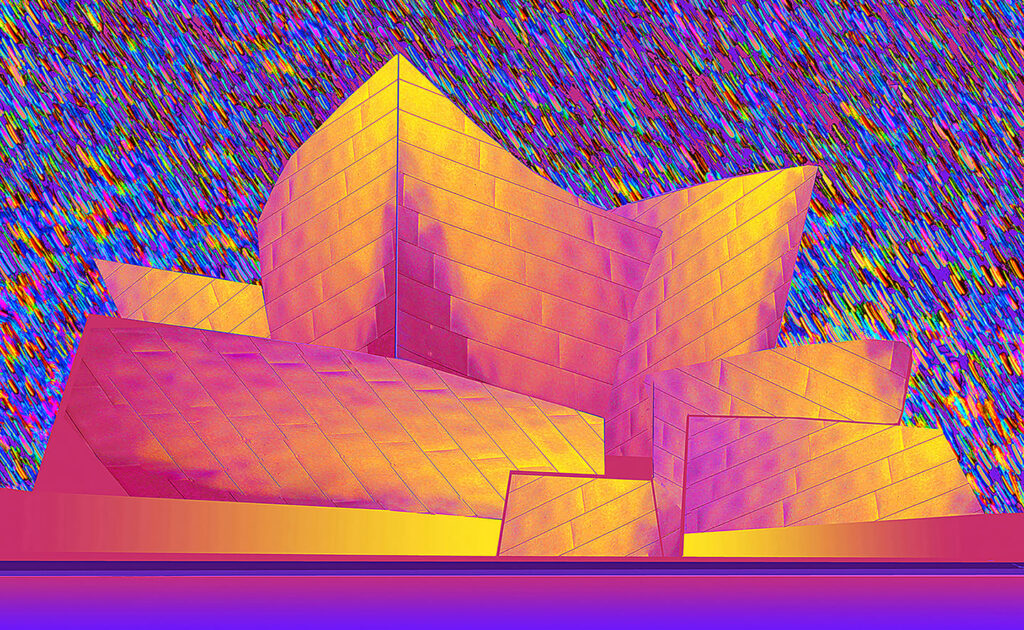
Nowhere is this evolution more visible than in her ongoing engagement with architecture, and in particular with the work of Frank Gehry. Gottlieb photographed for Gehry many years ago and has remained an admirer of his architecture ever since, returning again and again to his structures as subject matter. Her photographs of his buildings in Bilbao and Los Angeles form one of the more sustained threads in her career, a body of work in which architecture stops being a static backdrop and becomes active material for artistic transformation.

What separates these images from conventional architectural photography is what happens after the shutter clicks. Gottlieb has described using Photoshop to paint, combine, and enhance her photographs, treating the software not as a corrective tool but as an extension of her imagination. Gehry’s curved, reflective, often improbable forms give her plenty to work with: surfaces that already bend light in unusual ways become launching points for further manipulation, further color, further reinvention.
The result is photography that behaves like a conversation between two artists working in different mediums, decades apart. Gehry builds structures that refuse straight lines and easy categorization. Gottlieb photographs them, then pushes them further still, layering color and composition until the building becomes something closer to a painted memory of itself.
Thirty Years On
Few photographers sustain a singular visual identity across three decades without repeating themselves. Gottlieb’s longevity is worth pausing on. Her subjects have ranged widely, from everyday objects to major architectural landmarks, yet the through-line of color, light, and transformation remains constant. Her photographs have been exhibited by galleries, museums, and universities around the world, a testament to a body of work that has found audiences well beyond any single scene or movement.
What keeps her practice from calcifying into formula is her evident appetite for continued experimentation. She does not appear to be an artist coasting on an established style. Rather, each new series, particularly the architectural work built around Gehry’s buildings, reads as an extension of an ongoing inquiry into how far a photograph can be pushed before it becomes something else entirely.
A Vision Still in Motion
Gottlieb’s career resists the tidy arc so often imposed on artist profiles: struggle, breakthrough, mastery. Her story is less linear and more cumulative, a matter of decades spent refining an instinct rather than chasing a single defining moment. What emerges is an artist whose relationship to color and light has become almost a second language, one she continues to speak fluently and, by all evidence, is still finding new ways to use. In an art world often preoccupied with novelty for its own sake, Gottlieb’s steady, decades-long deepening of a single visual obsession feels like its own quiet argument for patience.
Step inside Jane Gottlieb’s vivid world of saturated hues and reimagined architecture. Visit janegottlieb.com to view her full fine art portfolios and exhibition archives.