

Carolina Tabares Botero has been painting since 2005, developing an artistic practice shaped by personal experiences, cultural transitions, and a continuous search for creative freedom. Her journey began in Colombia, where she initially focused on reproducing classical works by renowned artists such as Degas and Rembrandt. Over time, her practice evolved significantly, moving away from traditional realism toward expressive abstraction and a more personal exploration of the feminine figure.
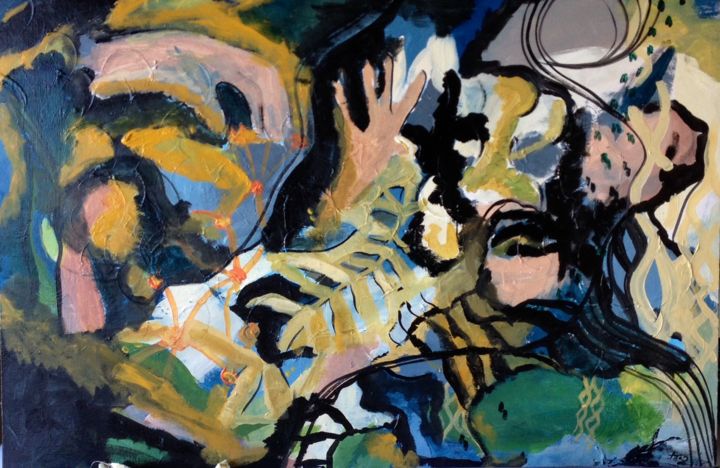
Today, Carolina primarily works with acrylic on canvas, creating paintings that move between abstract and figurative forms. Her vibrant colors, expressive gestures, and dynamic compositions reflect an ongoing journey of self-discovery. Through her art, she explores themes of femininity, identity, liberation, and emotional experience, translating her observations and personal evolution into a distinctive visual language.
The Beginnings of an Artistic Journey
Carolina’s artistic journey began in 2005, when she started painting in Colombia. During the early stages of her practice, she focused primarily on reproducing classical artworks, studying the works of artists such as Degas and Rembrandt.
This period provided an opportunity to develop her technical skills and deepen her understanding of painting. Reproducing the work of established masters requires careful observation and attention to composition, color, light, and form. For Carolina, this early experience helped establish a foundation that would later support her own artistic experimentation.
Alongside her painting practice, she also worked on murals in commercial environments. This introduced her to a larger scale of artistic expression and allowed her to experience the relationship between art and public or commercial spaces.
These early experiences became important steps in her development. Although her artistic language would eventually change considerably, the technical knowledge and discipline gained during this period remained part of her creative foundation.
A Life-Changing Move
In 2010, Carolina relocated to New Zealand. The move represented an important turning point in both her personal life and artistic development.
Moving to a new country can bring new perspectives, experiences, and ways of seeing the world. For Carolina, her new surroundings introduced her to a society where the empowerment and freedom of women were prominent aspects of the cultural environment she experienced.
This exposure had a profound effect on her creative direction. Her work began to move away from the realistic style that had characterized much of her earlier practice and toward a more expressive and abstract approach.
The change was not simply a shift in technique. It reflected a deeper personal transformation and an evolving relationship with the subjects she wanted to explore.
Exploring the Feminine Through Art
The feminine figure has become a central focus of Carolina’s artistic practice. Through her paintings, she explores the complexity of femininity while considering themes of identity, freedom, and personal expression.
Her approach to the feminine subject is not limited to realistic representation. Instead, she uses abstraction, expressive forms, and vibrant colors to communicate ideas and emotions that may exist beyond the physical appearance of the figure.
The human form becomes a starting point for deeper exploration. A figure may be recognizable while simultaneously being transformed through expressive shapes, exaggerated forms, and energetic brushwork.
This approach allows Carolina to explore the feminine experience in a way that feels personal and emotionally open. Her paintings suggest that identity is not fixed or easily defined but is instead something that can evolve through experience, self-reflection, and freedom.
From Realism to Expressive Abstraction
One of the most significant developments in Carolina’s career has been her transition from realism to expressive abstraction.
Her early work involved studying and reproducing the techniques of classical masters, while her current practice gives greater importance to emotion, intuition, and personal interpretation.
This evolution demonstrates a growing confidence in her own artistic voice. Rather than relying on established visual structures, Carolina now creates paintings that allow her to respond more directly to her experiences and observations.
Abstraction gives her the freedom to communicate through color, movement, and form. It allows her to express emotions that may not be easily represented through realistic imagery.
At the same time, her work continues to maintain connections to the figurative tradition. The human figure often remains present within her compositions, creating a bridge between the recognizable and the abstract.
This balance is central to her artistic identity. Her paintings can suggest a figure without completely defining it, allowing viewers to experience both the physical and emotional dimensions of the work.
A World of Vibrant Color
Color is one of the most powerful elements in Carolina’s paintings. Her use of vibrant tones contributes to the emotional energy of her compositions, creating artworks that feel expressive and alive.
Rather than using color simply to reproduce reality, she treats it as a language in itself. Bright hues can communicate energy, confidence, freedom, or emotional intensity, while combinations of contrasting tones can create tension and movement.
Her colors often work alongside dynamic forms and expressive gestures, resulting in compositions that feel active and spontaneous. The interaction between these elements encourages viewers to experience the artwork emotionally rather than simply observing it from a distance.
This use of color reflects Carolina’s broader interest in personal expression. Her paintings are not simply records of what she sees; they are interpretations of how she experiences the world.
Between Expressionism and Naive Art
Carolina’s artistic practice encompasses a range of styles, including expressionism and naive art, as well as more abstract compositions.
Expressionism provides her with a way to emphasize emotion and personal response. Through expressive forms and vibrant colors, she can communicate feelings that might otherwise remain difficult to articulate.
Her engagement with naive art introduces another dimension to her practice. This approach can bring a sense of simplicity, spontaneity, and directness to visual storytelling, allowing her to approach subjects without being overly constrained by traditional expectations of realism.
Together with her abstract work, these influences contribute to a practice that remains flexible and open to experimentation.
Rather than committing herself to one strict category, Carolina allows different artistic approaches to coexist. This diversity reflects her belief in the importance of following creative intuition and responding honestly to the subject and emotion at hand.
Art as a Journey of Liberation
For Carolina, painting has become closely connected to the ideas of self-discovery and freedom. Her artistic evolution mirrors a personal journey in which she has gradually moved toward a more individual and expressive creative voice.
The shift from reproducing classical works to developing expressive and abstract compositions represents more than a change in style. It reflects a growing sense of independence as an artist.
Her paintings allow her to explore questions of identity and femininity while also reflecting her experiences of adapting to a new environment. Through the process of painting, she transforms these experiences into visual narratives that are personal yet open enough for viewers to find their own connections.
The feminine figures within her work can therefore be understood as symbols of strength, vulnerability, transformation, and liberation. Their forms and colors suggest an emotional world in constant movement.
An Evolving Artistic Identity
Carolina Tabares Botero’s artistic journey demonstrates how an artist’s visual language can evolve alongside personal experiences. From her early years studying classical painting to her current exploration of abstraction and expressive figurative forms, her practice has continually expanded.
Her move to New Zealand became an important catalyst for this transformation, introducing new perspectives that encouraged her to explore themes of feminine identity and freedom more deeply.
Working primarily with acrylic on canvas, Carolina combines vibrant colors, expressive forms, and dynamic compositions to create paintings that reflect her ongoing search for meaning and self-understanding.
Her work exists between the figurative and the abstract, allowing her to maintain a connection to the human form while exploring the emotional possibilities of color and shape.
Ultimately, Carolina’s paintings are expressions of an artist who continues to discover herself through the act of creating. Her journey demonstrates how art can become a form of liberation—a way to process experiences, explore identity, and transform personal observations into something meaningful.
Through her vibrant and expressive paintings, Carolina Tabares Botero invites viewers into a visual world where the feminine figure becomes a symbol of exploration and freedom. Her evolving practice continues to reflect a deep commitment to self-expression, demonstrating that an artist’s greatest journey may be the ongoing process of discovering their own voice.