

For most of her career, Lib Mason painted for other people. As a commercial illustrator whose work appeared in publications like Rolling Stone and Time Life Warner, and later as the creative force behind several artist-branded licensed product lines, her subjects, deadlines, and even her palette were often dictated by someone else’s brief. Today, as a contemporary oil painter working in a technique borrowed from the Flemish masters, Mason answers to no one but the painting itself, and the results are stranger, funnier, and more unsettling than anything a client could have commissioned.
From Assignment to Inquiry
Mason’s training began at the Rhode Island School of Design, where she studied editorial illustration, a discipline built on communicating a message quickly and clearly for a reader who might glance at the page for only a few seconds. That skill served her well through decades of commercial work. But roughly eight years ago, when she stepped away from that career, she was left with a question that illustration work rarely allows an artist to ask: what would she make if nothing but her own curiosity determined the subject?
Her answer was not a return to easy illustration. It was a shift into oil painting built on a demanding, historical process, one that trades the speed of commercial deadlines for the patience of Old World technique.
A Technique Built on Patience
Every painting Mason makes begins the same way: not with color, but with a grisaille, a monochrome underpainting that establishes form, value, and the behavior of light before a single hue enters the picture. Once that structure is resolved, she builds the image slowly, layering multiple transparent glazes over the grisaille so that color and luminosity develop gradually, the way light seems to rise from within the panel rather than sit on its surface. It is a process associated with Flemish and Renaissance painting, and it demands a kind of patience that stands in direct contrast to the fast turnaround of her earlier commercial career.
That contrast is not incidental. Mason uses this historical language deliberately to address subjects pulled directly from the present, political, social, and environmental events that she has no interest in illustrating literally. Instead, she filters them through beauty, symbolism, humor, and occasional absurdity, creating pictures that pull a viewer in visually before revealing what they are actually about.
Three Paintings, Three Confrontations
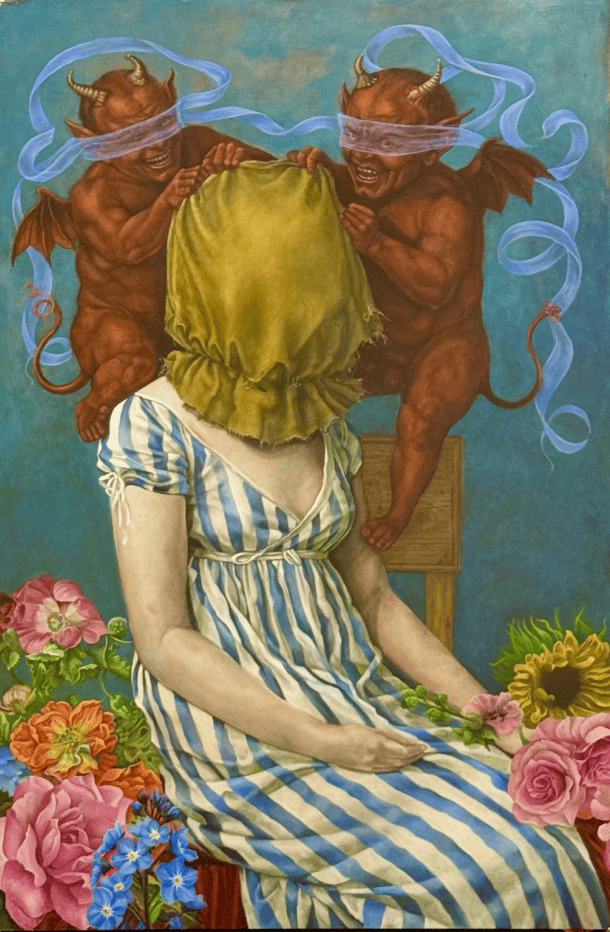
That strategy is on full display in RIP ICE, a 2026 oil on panel painted in response to the shooting of Renee Good. Two grinning, blindfolded devils pull a hood over a seated woman, the scene rendered in brilliant color and surrounded by flowers. Mason painted the woman’s skin chalky, pale, and uneven, a deliberate refusal to let her be defined by race or identity, so that she can stand in for anyone. The devils’ blindfolds suggest force acting without truly seeing the person in front of it, a visual argument for what happens when power operates unchecked.
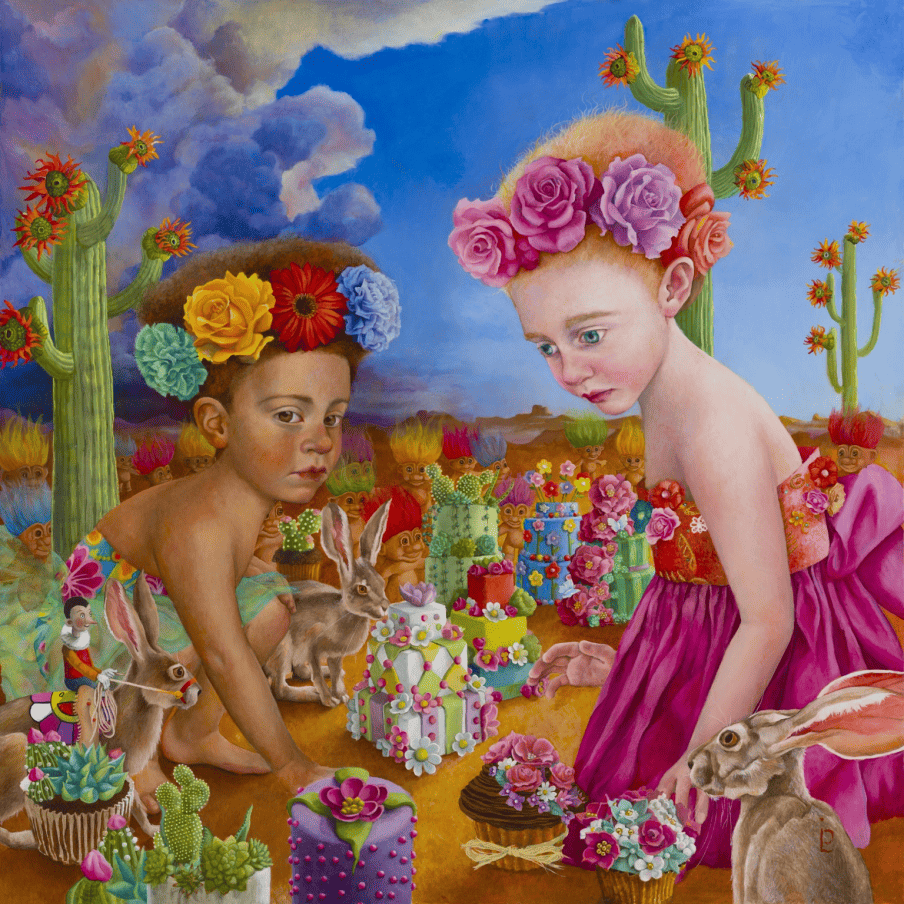
Esparza, Nadine and the Beautiful Wall takes on the border wall between Mexico and the United States, a structure Mason found both troubling and absurd, not least for how it disrupts the natural migration of animals along with people. Rather than depict the wall itself, she imagined what innocence might build in its place: two young girls constructing their own wall, made entirely of cakes, meant not to keep out people but to keep out trolls. Pinocchio looks on as a small witness, a quiet nod to how difficult it has become to separate truth from noise.
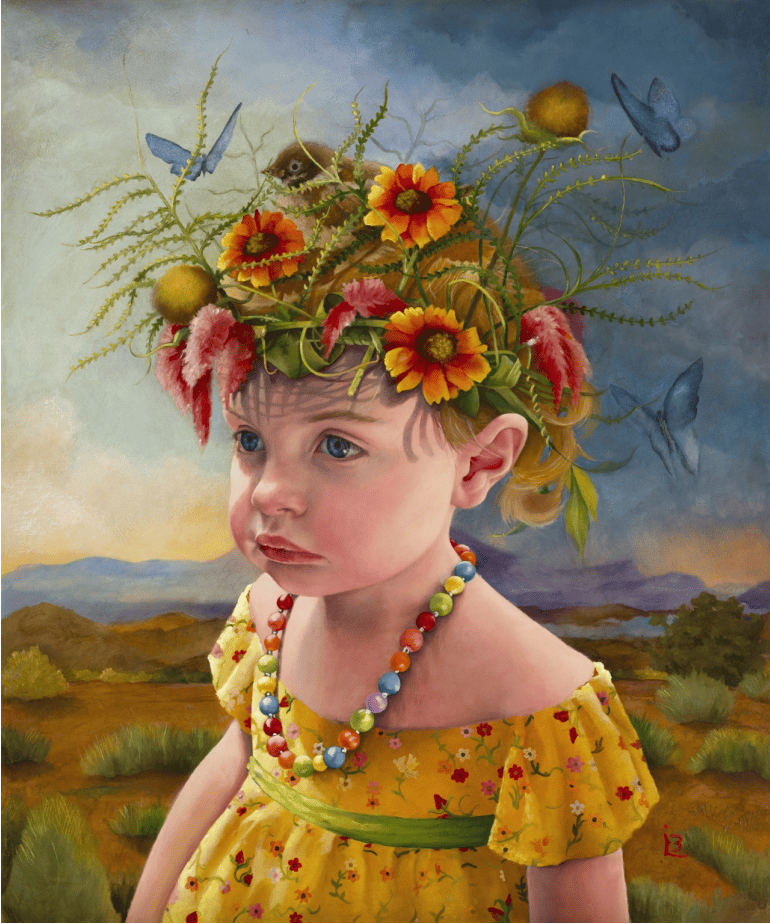
Flight turns toward environmental anxiety. A young girl stands alone in a barren landscape, a figure who is both witness and symbol. The painting doesn’t argue a policy position; it simply asks what kind of planet is being left behind for the children who will inherit it.
Where History Meets the Present
What unites these three works is not subject matter so much as method. Mason is not interested in making protest paintings in any conventional sense. By routing contemporary anxieties through a technique inherited from centuries-old painting traditions, she creates a friction between the beauty of the surface and the difficulty of the content, one that asks the viewer to sit with discomfort a little longer than a headline would allow.
It is worth remembering that Mason arrived at this practice only after decades spent making pictures on assignment. That history is not separate from the work she makes now; it is part of what gives her current paintings their unusual confidence. She knows exactly how to hold a viewer’s attention. What she does with that attention, now that it is entirely her own to direct, is where the real interest of her painting lies.
Lib Mason’s current body of work suggests that returning to painting later in a career, freed from the constraints of commercial illustration, does not mean returning to something smaller. It means returning to something built entirely on her own terms, contemporary in subject, historical in language, and unwilling to let either beauty or difficulty cancel the other out.
Explore more of Lib Mason’s latest works and exhibition updates on her official website
. For a behind-the-scenes look into her studio process and daily studio updates, follow her on Instagram @libmason5687.